
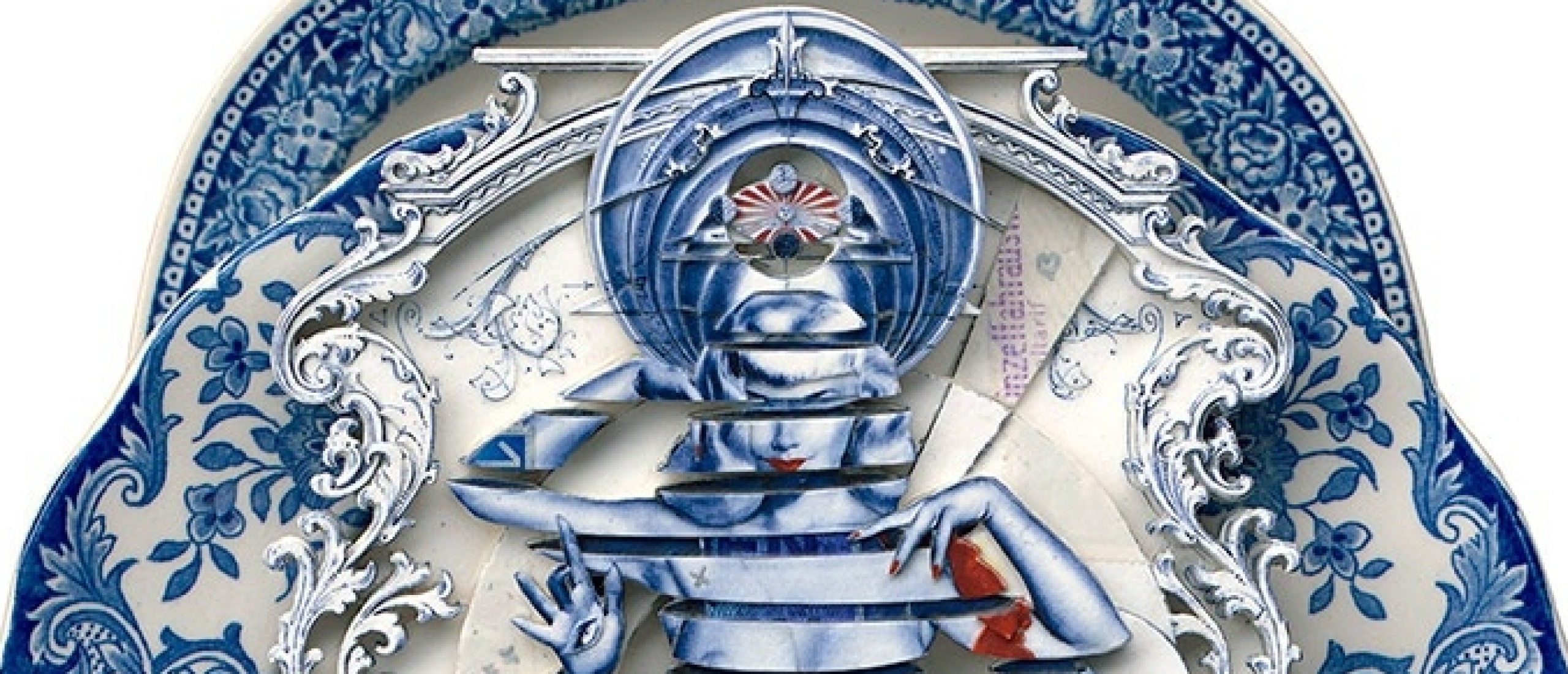

Fragments Of Eroticism: Collage And Proliferation In the Work Of Hanneke Treffers (Aka. Handiedan)
Collage Between Unity and Fragmentation
Collage carries within its very procedure a tension between unity and fragmentation. Unlike painting or drawing, in which the image may emerge from a surface subjected to a continuous process of construction, collage begins with materials that previously existed independently. Photographs, prints, printed papers, documents, ornaments, and typographic fragments are removed from their original contexts and brought together in a new configuration. Cutting, therefore, does not constitute merely a technique, since it can disrupt previous relationships in order to allow new ones to emerge. This characteristic brings collage close to the grotesque, understood not only as the representation of the monstrous or the deformed, but also as a procedure capable of questioning the boundaries that keep bodies, objects, and categories separate. The work of Hanneke Treffers (Sprang-Capelle, the Netherlands, 1981), known as Handiedan, explores this characteristic through compositions in which female bodies, ornaments, diagrams, playing cards, documents, coins, and other printed materials accumulate in multiple layers.
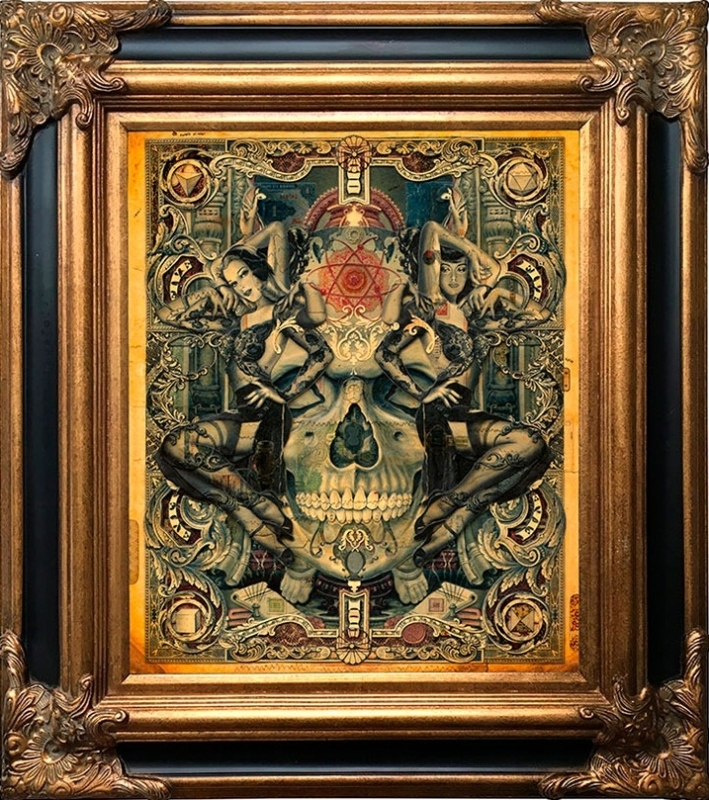
Fig.1 "Zwarte Vlinder (Black Butterfly)"
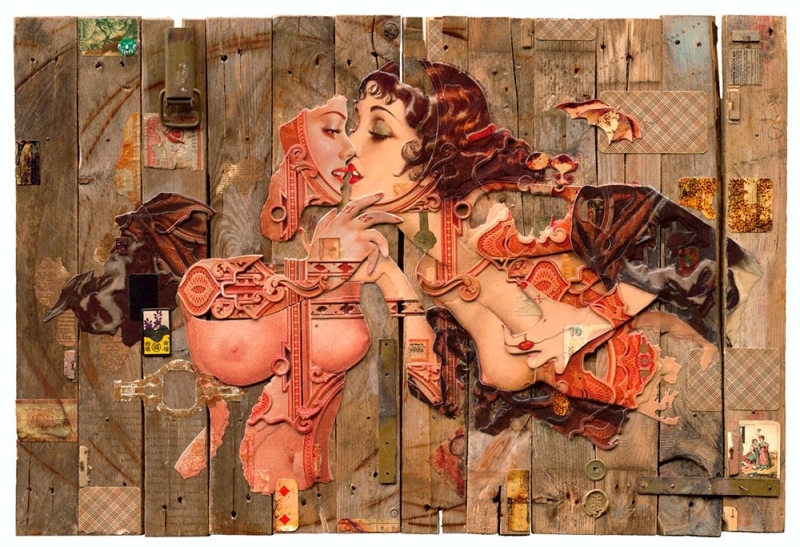
Fig.2 "Zoen (Kiss)"
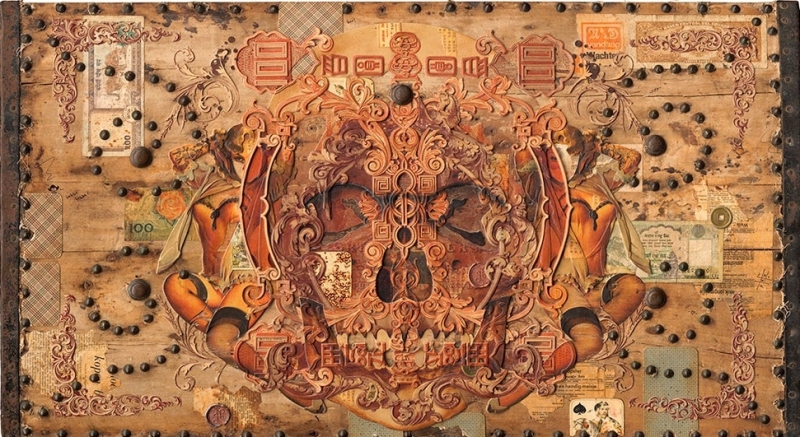
Fig.3 "Virgo et Mortis"
Between Digital Construction and Material Assemblage
Handiedan began developing her mixed-media collage practice in 2007, following training in photographic design and experience in illustration and graphic design. Her process combines digital and manual procedures. Parts of the compositions are created from digitized and manipulated images before being printed, cut out, and rearranged. The artist adds found or collected materials, including maps, stamps, certificates, sheet music, playing cards, cigar bands, and papers bearing traces of use. Some works are installed in antique frames, allowing the frame to participate in the composition rather than functioning merely as a boundary between the work and the surrounding space.
Through this procedure, the artist produces a relationship with time that cannot be reduced to the quotation of past styles, since the materials she uses retain traces of the functions they possessed before entering the collage. A playing card, for example, remains recognizable as a card; a stamp retains its connection to systems of circulation; a banknote refers to economic value; a map preserves traces of its function of representing and organizing space. Once cut and superimposed, however, these objects cease to perform their original functions, becoming instead parts of bodies, halos, geometric structures, and ornamental patterns. Collage consequently brings together systems that previously had no relationship with one another.
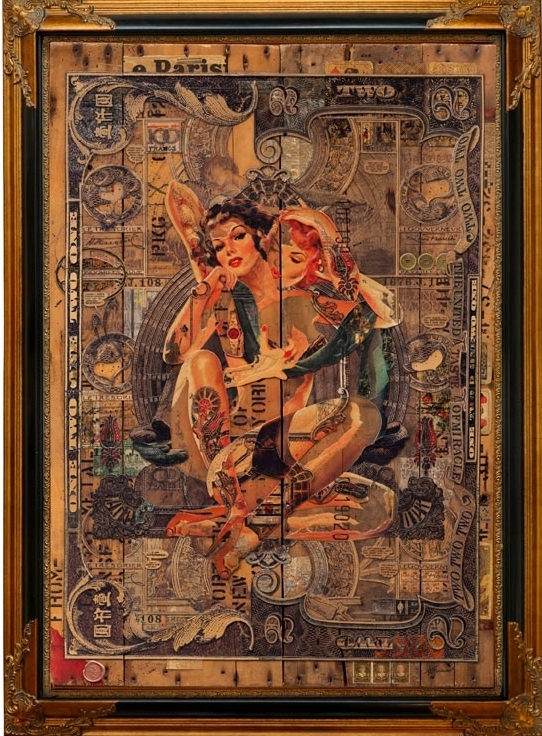
Fig.4 "United Taste of Miracle"
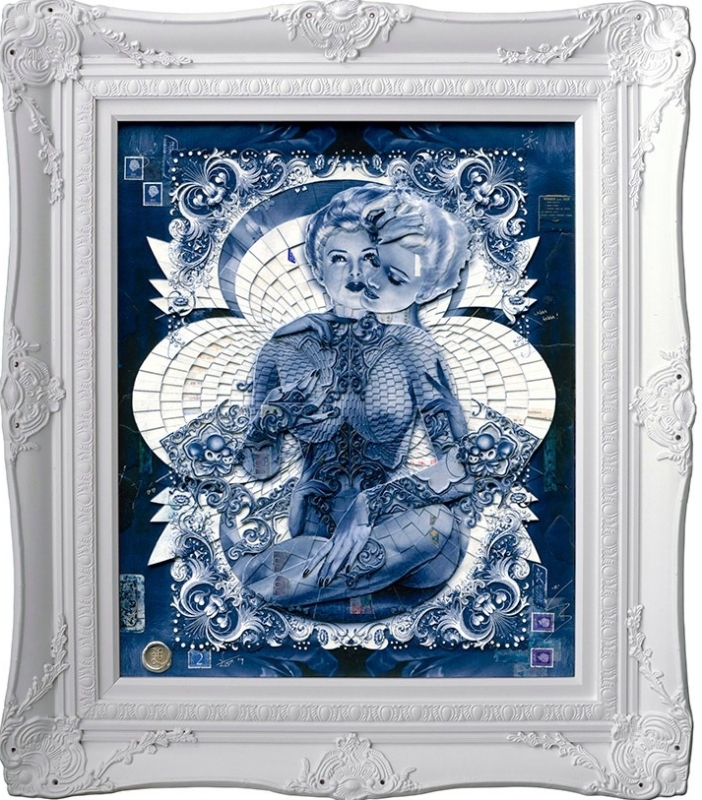
Fig.5 "Torus in Blue"
The Female Body as a Fragmented Construction
In Handiedan's pin-up collages on wood and metal from around 2009, these compositional strategies can be observed in the way the female figure occupies the vertical axis of the composition. Her pose draws on the visual repertoire of pin-ups, with crossed legs, high heels, bodily exposure, and a posture arranged to direct the viewer's gaze. Yet what we encounter is not a continuous body, since the torso, arms, and legs are intersected by rectangles, circles, lines, diagrams, and fragments of other images. Some areas seem to have been removed and replaced, while others remain visible only because the superimposed elements leave small portions of the anatomy exposed. The artist herself described her practice during this period as a combination of photomontage, cutting, and collage incorporating vintage cards, sheet music, money, stamps, paper, wood, and oxidized metal.
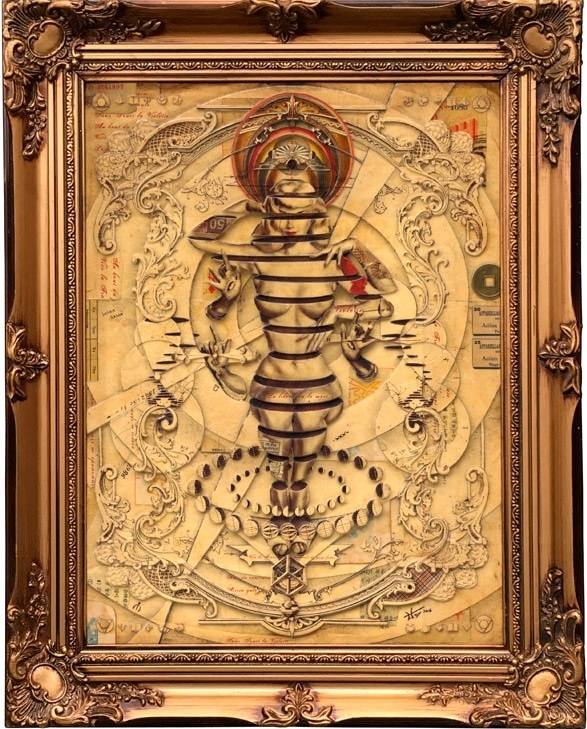
Fig.6 "Tetrade"
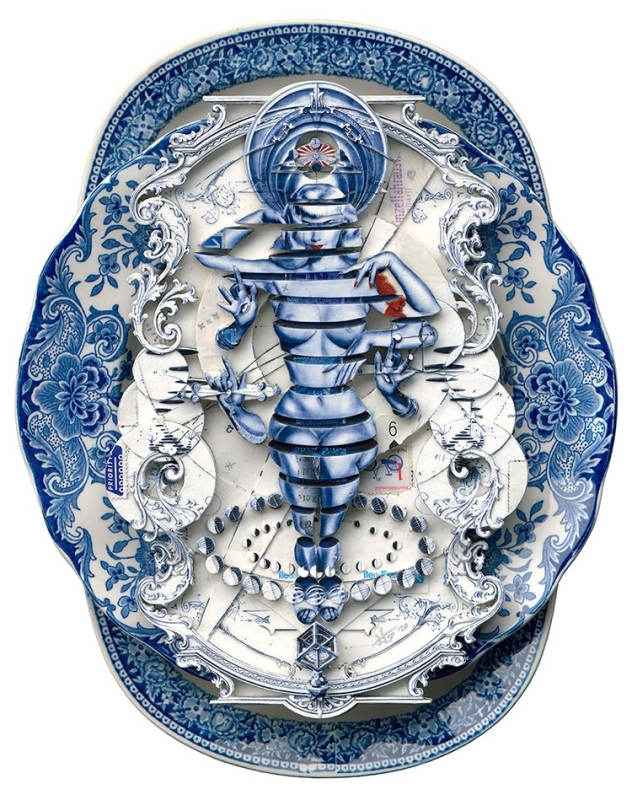
Fig.7 "Tetrade in blue"
Become a Premium member now and check out the extended version of this publication including, among other things:
- a further analysis of Handiedan's erotic collages
- the aesthetics of pin-ups, eroticism, and the impossible body
- why there is something akin to Frankenstein's creature in this procedure
- the function of the wooden frames
- her use of the symmetrical axis
- numerous additional works
Handiedan has the following website and is also active on Instagram
Click HERE for an article about the montage, collage, and eroticism in the work of Steven Stapleton
What do you think about Handiedan's erotic collages? Leave your reaction in the comment box below...!!