
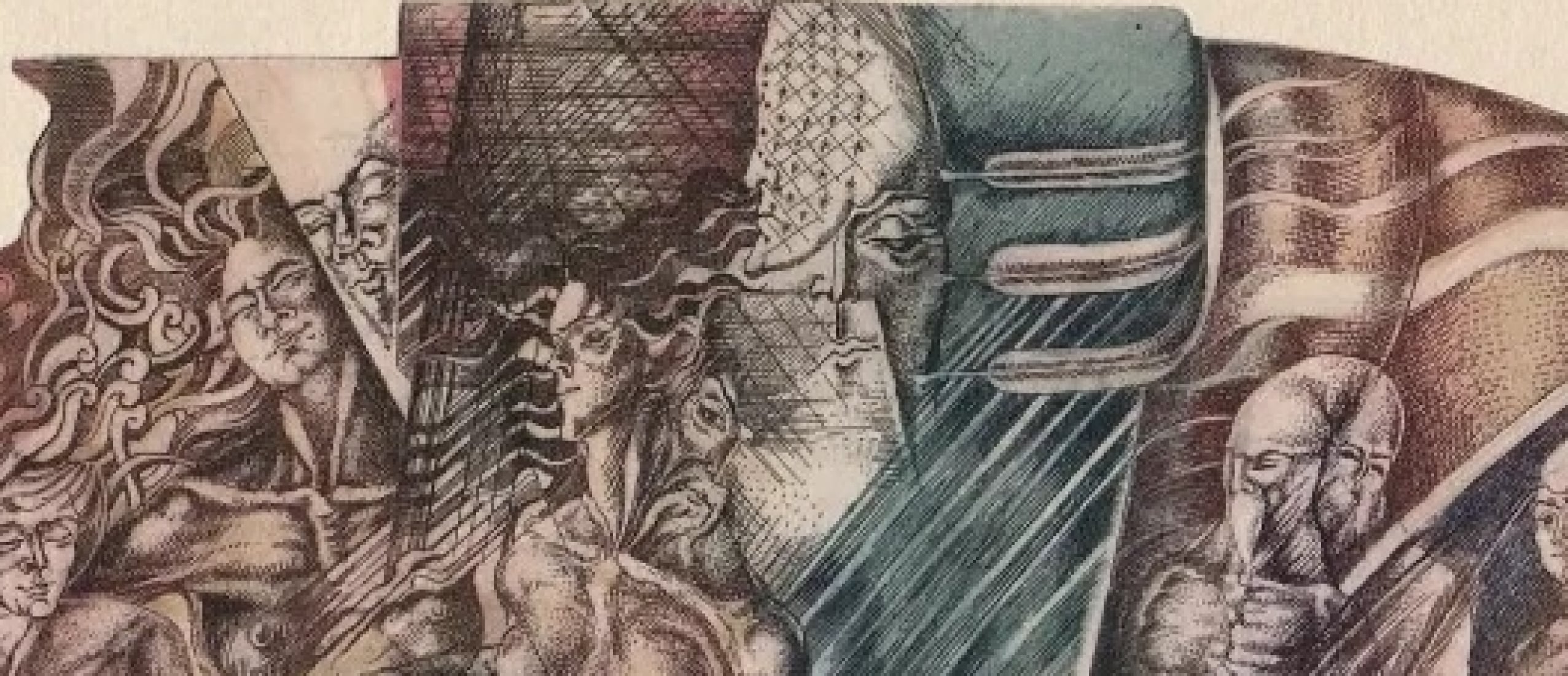

Tradition In the Digital Age
The work of Romanian-American artist, printmaker, and graphic designer Elena Hlodec (1972-) stands out in a historical moment marked by the proliferation of digital images and the accelerated circulation of visual languages. Her work reaffirms the continuing relevance of traditional image-making practices without turning them into exercises in nostalgia. Rather than embracing digital production, her work explores centuries-old techniques capable of producing works that engage with contemporary issues through rigorous formal elaboration and a constant investigation into symbols, memory, and the construction of the imaginary.
This understanding of art appears explicitly in her text "Bareness of the Symbol," published in 2005 in the journal Tertulia. Rather than being merely an aesthetic manifesto, the essay constitutes a reflection on the creative process itself. In it, Hlodec asserts that a work of art is born neither from manual skill nor from the ease of a gesture, but from composition. For her, technical mastery is merely the outcome of sustained visual thinking, while true creation requires a structure capable of organizing formal relationships, rhythms, tensions, and meanings. Thus, the artist rejects both empty virtuosity and the artificial intellectualization of artistic production, arguing that an image only acquires consistency when it results from continuous work on a restricted set of formal problems.
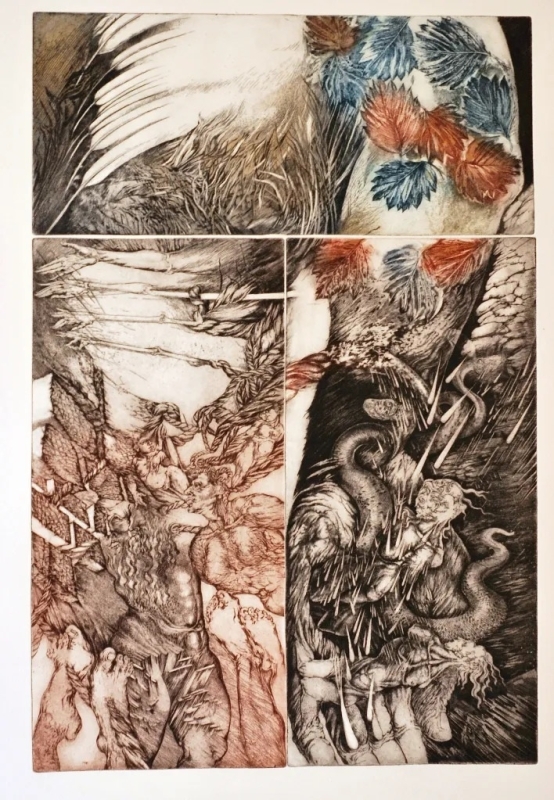
Fig.1 Antithesis fallen conquest
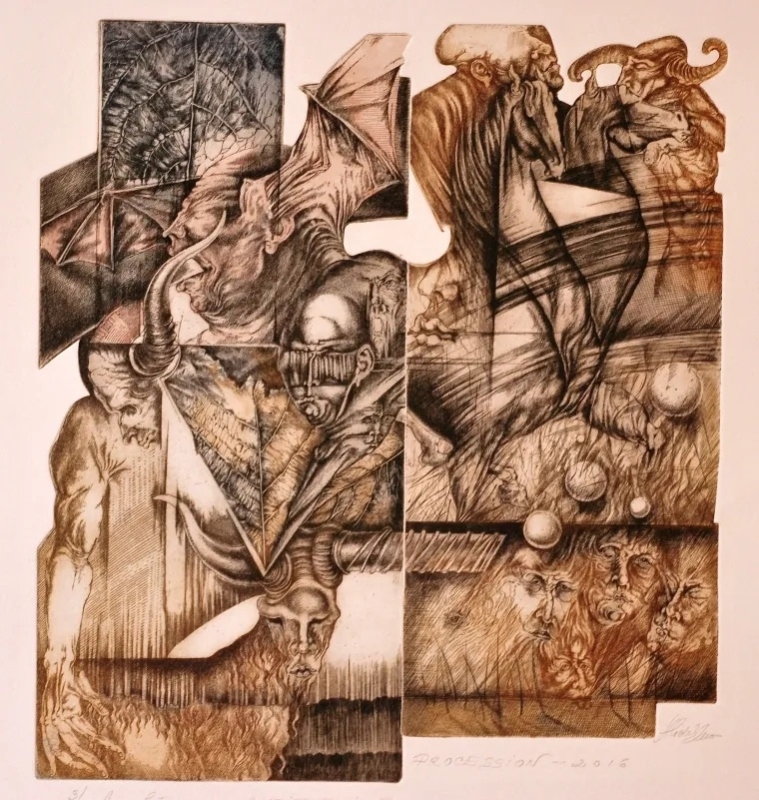
Fig.2 Antithesis, Procession
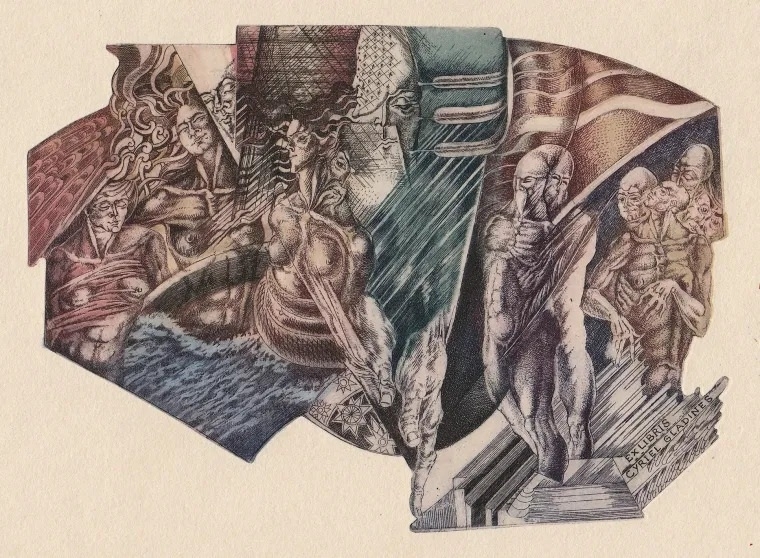
Fig.3 Divina Comedia – The Sunset Messenger, C3, 2017, Cyriel Gladines
The Symbol As a Living Organism
This position helps in understanding the entirety of her work; instead of seeking renewal through a constant change of themes, Elena Hlodec repeatedly returns to certain iconographic motifs, developing them over the years under different configurations. In this way, the symbol becomes an organism in continuous transformation, as forms reappear, undergo displacements, establish new relationships, and acquire new meanings without losing their fundamental identity. Consequently, repetition is not mere repetition, but rather a method of deepening.
Trained at the "Nicolae Tonitza" School of Fine Arts in Bucharest, and later earning a Master’s degree from the National University of Arts of Romania in drawing, engraving, and graphic arts, Elena Hlodec developed her career in an environment where the Romanian graphic tradition has always occupied a relevant position. Romanian printmaking developed throughout the 20th century through the coexistence of classical techniques and formal experimentation, a circumstance that allowed Hlodec to build her own language based on both technical mastery and the conceptual elaboration of the image.
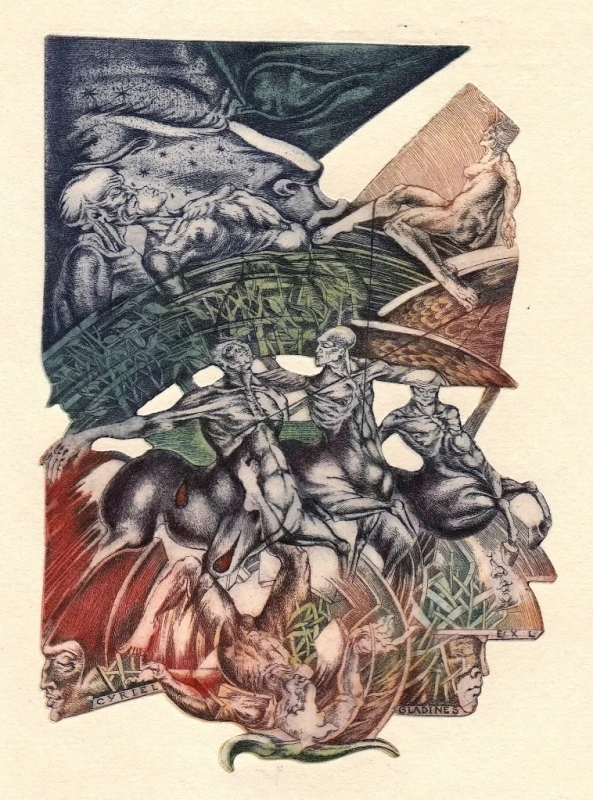
Fig.4 Divina Commedia - Rainbow, C3. 2107 – Cyriel Galdines
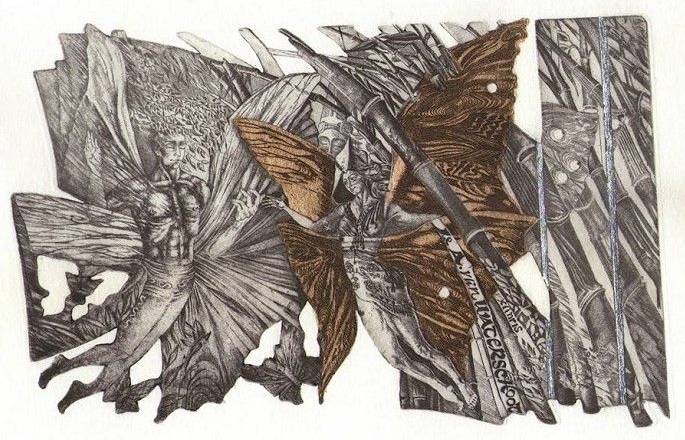
Fig.5 Elena Hlodec Ex-libris
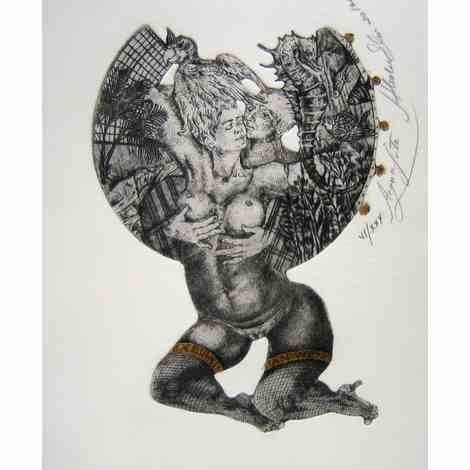
Fig.6 Artwork (2012)
The Autonomy Of the Ex Libris
Her international career began in the 1990s when she started participating in important competitions dedicated to the ex libris in Serbia and Belgium. These events played a decisive role in establishing her within an international community of highly specialized printmakers working across woodcut, etching, engraving, drypoint, and other printmaking techniques. Originally conceived as marks of ownership placed inside books, ex libris gradually acquired autonomy as an artistic medium throughout the 20th century. Its reduced format demands compositional synthesis, graphic precision, and high symbolic capacity, such that each element must simultaneously perform narrative, ornamental, and identity functions. It was within these constraints that Elena Hlodec found a privileged field to develop her visual research.
While many artists treat the ex libris as a simple decorative exercise, Hlodec transforms it into a space of poetic elaboration, opting to create compositions that are rarely limited to the identification of the work's owner. Animals, female figures, plant elements, books, machines, scientific instruments, imaginary architectures, and literary references are organized into visual systems where each component establishes complex relationships with the others. The result is less akin to illustration than to the construction of condensed symbolic universes.
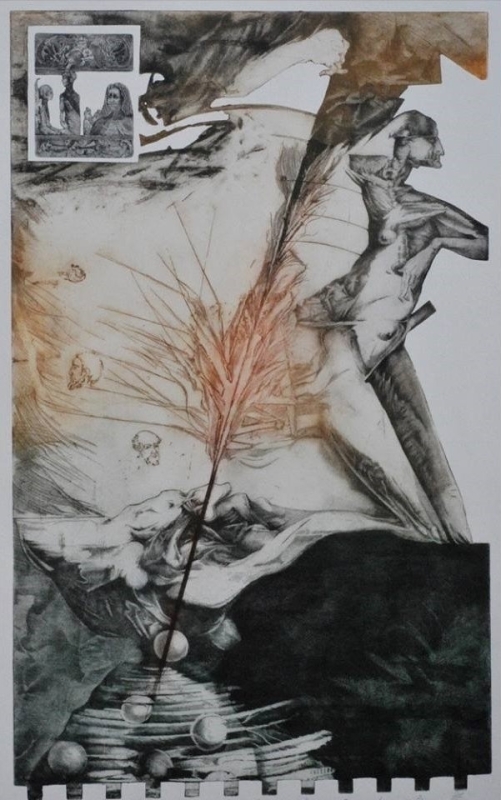
Fig.7 "L’Exercice d'Intelligence", 2012
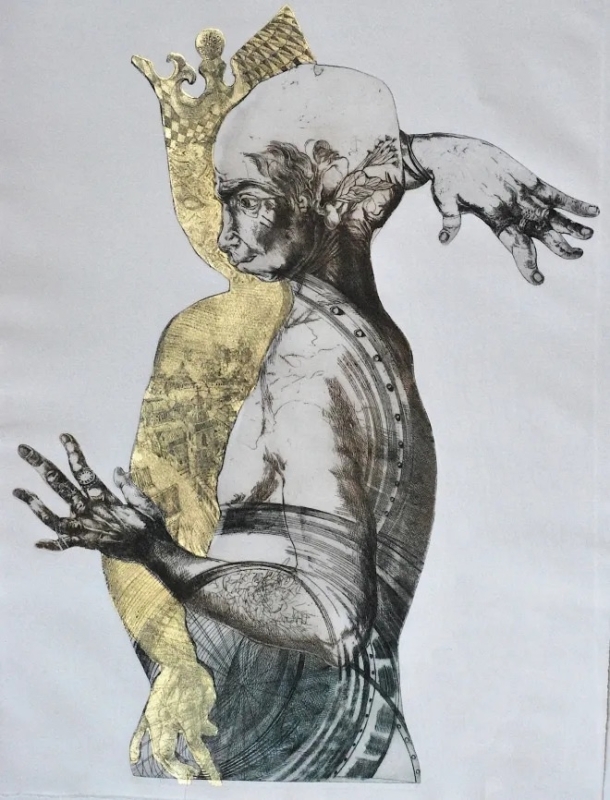
Fig.8 "Le Roi Du Silence", Gold Leaf, 2012
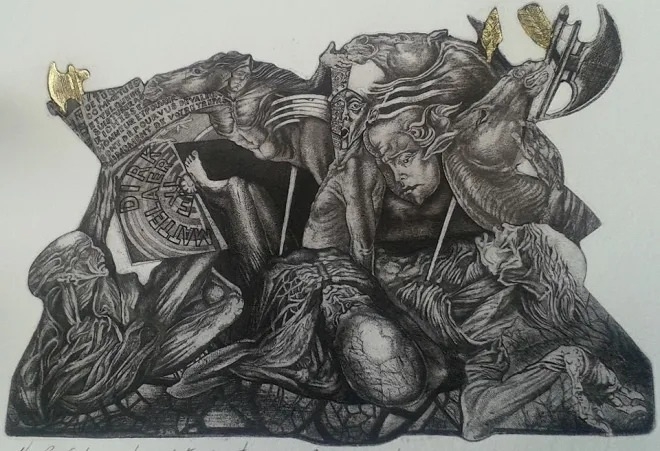
Fig.9 "Le Dit Des Trois Vifs et Trois Morts"
Become a Premium member now and explore the complete publication about Hlodec's erotic work including:
- The Eroticism and the Territory of Metamorphosis,
- Instability and the Dissolution of the Self,
- The Grotesque Body and Mikhail Bakhtin
- Moral States and Dante's Inferno
- The Rhizomatic Organism
Elena Hlodec is active on Instagram
Click HERE for the erotic ex-libris of Ruslan Agirba
What do you think about