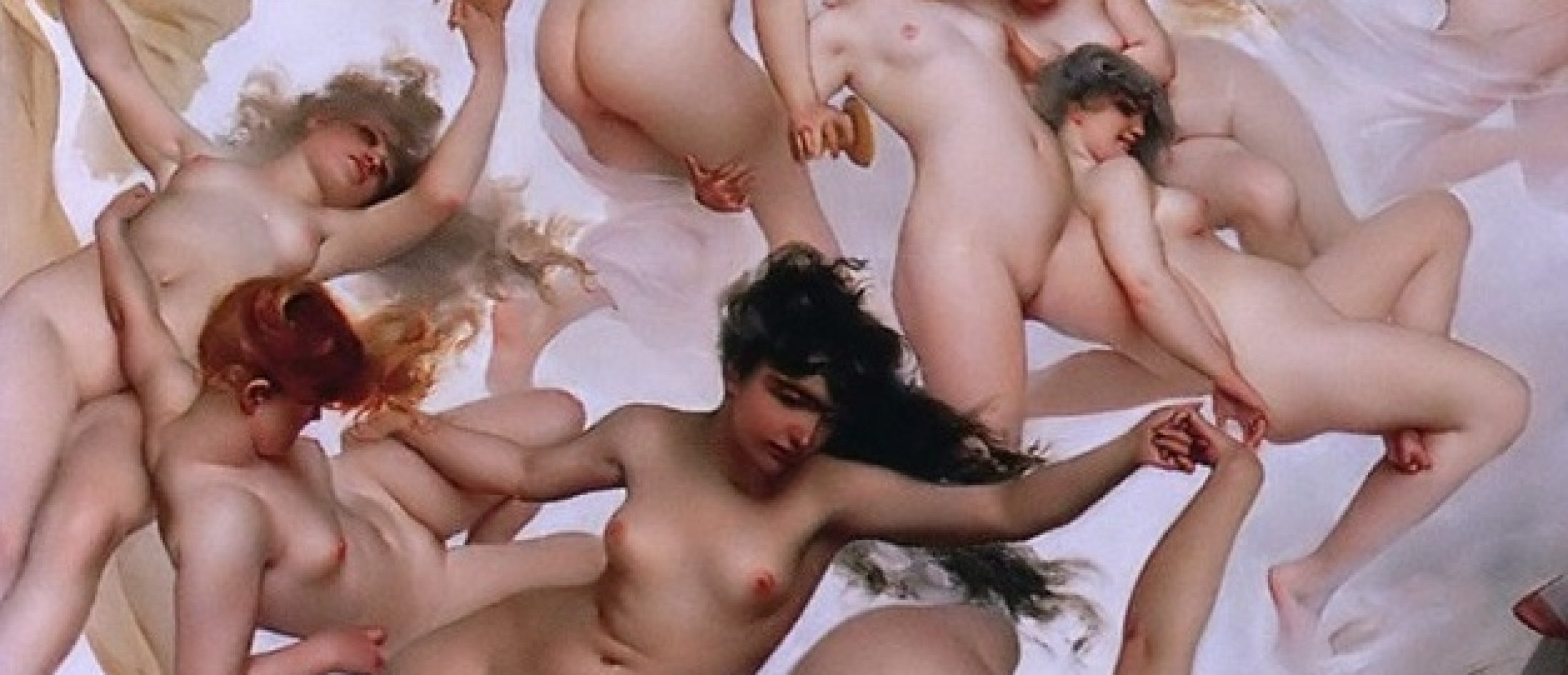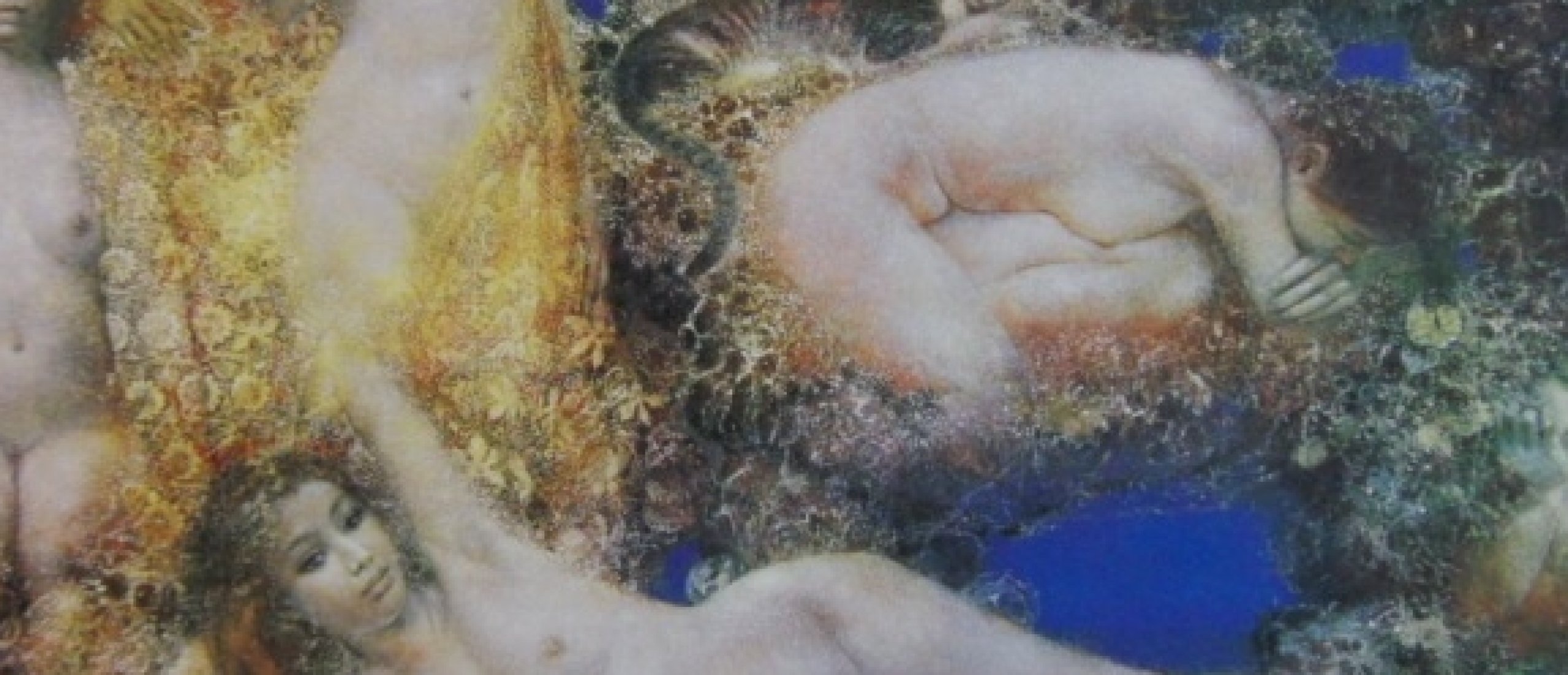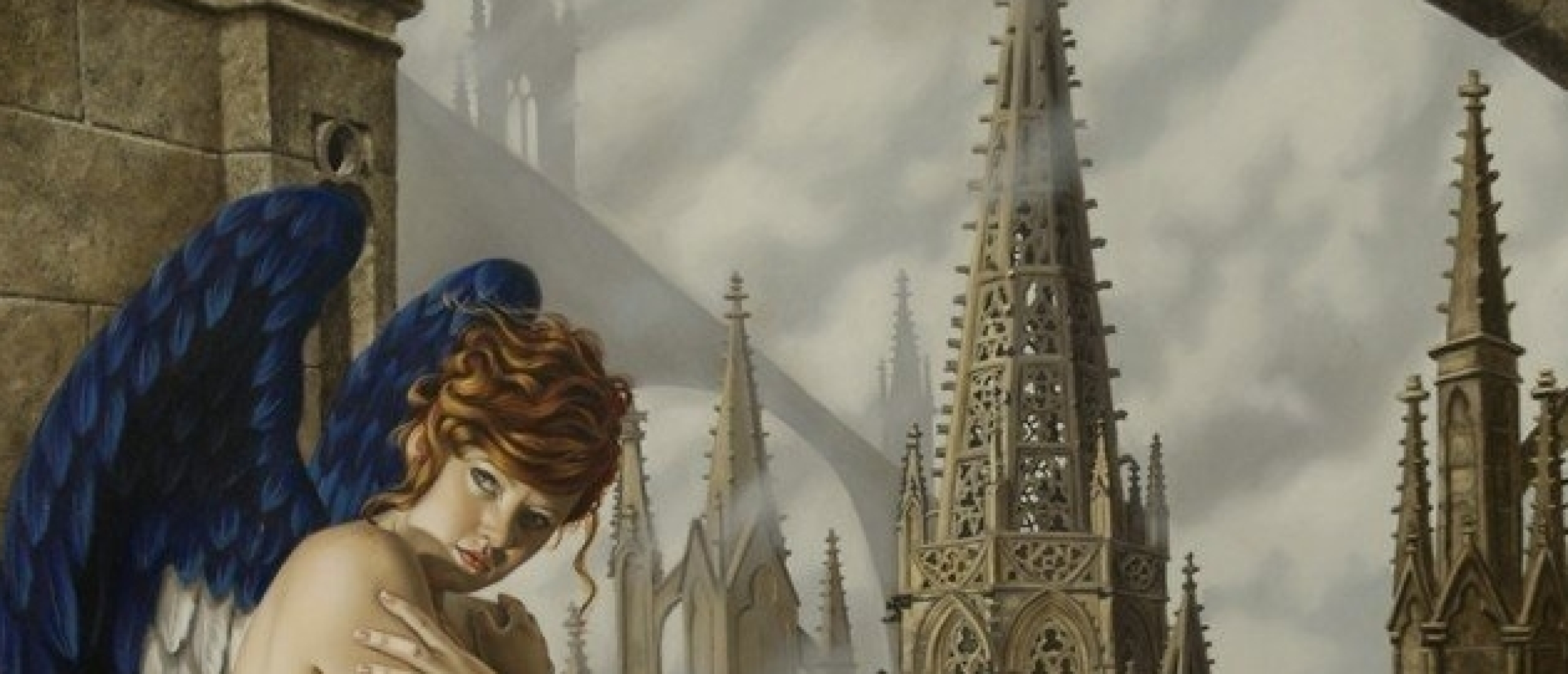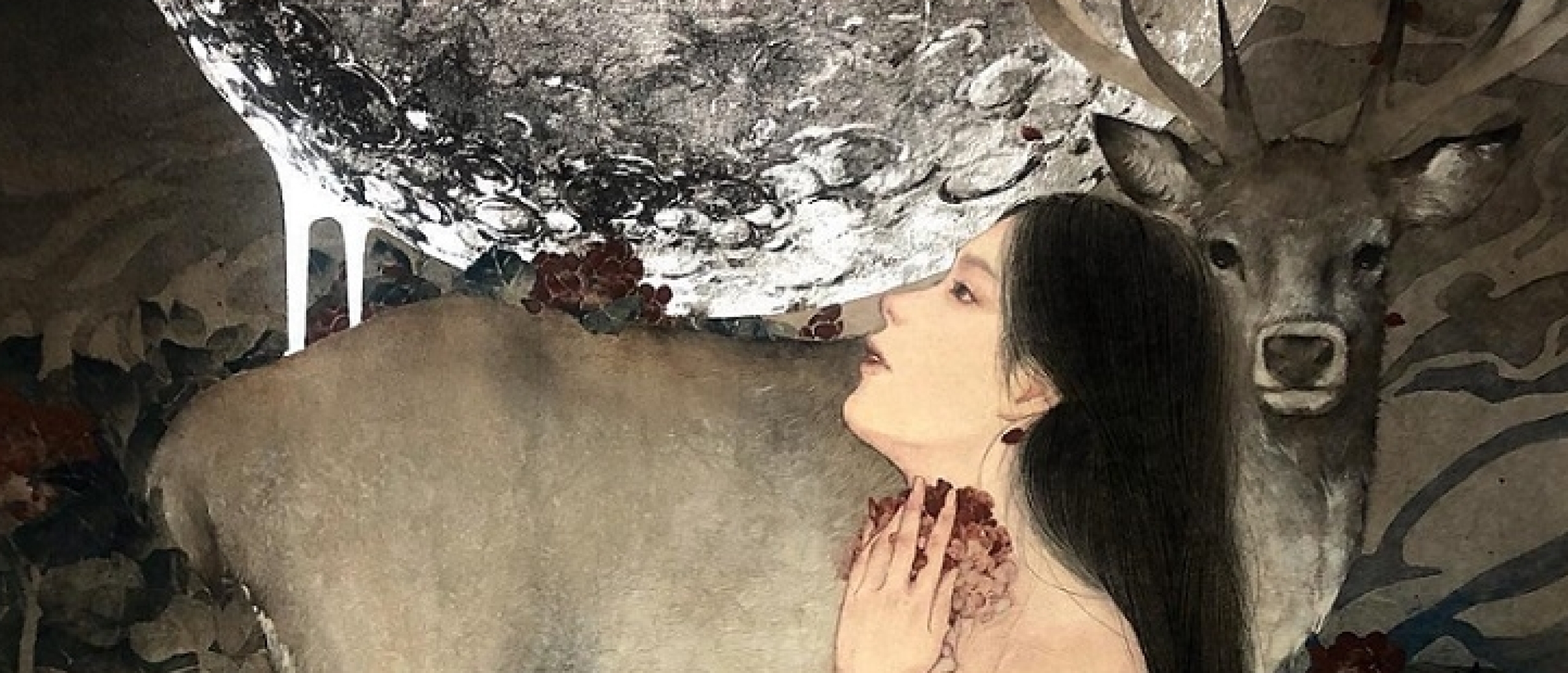
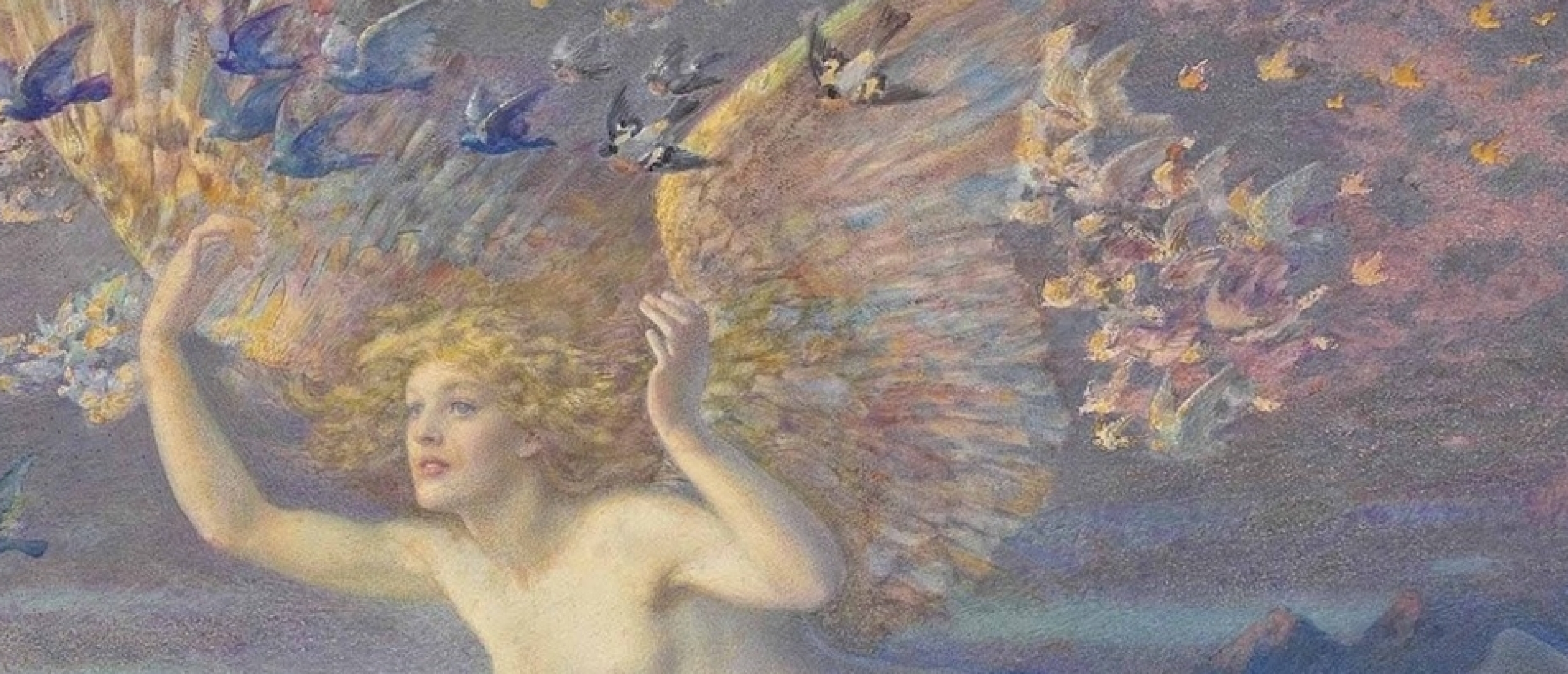

Across the history of the Western art, the sky has rarely been treated as empty space. Instead, the sky has functioned as a realm of mystery, divinity, transcendence and emotional projection. In many of the 19th and early 20th century paintings, artists transformed celestial and atmospheric phenomena into feminine forms, nude and eroticised feminine forms naturally, personifying rainbow, moonlight, night, stars, clouds and other states of the heavens through the female body. Works such as Henry Mosler’s ‘The Spirit of the Rainbow’ (1912–19), Gustave Moreau’s ‘Nyx, Night Goddess’ (1880), and Evelyn De Morgan’s ‘Moonbeams Dipping Into The Sea’ (1918) reveal a shared artistic impulse: the visualisation of the immaterial through feminine embodiment. In these paintings, women are not merely placed within nature; they become nature itself. The female figure acts as a vehicle through which artists render atmospheric and cosmic phenomena visible, emotional and spiritually legible. This article is not about the quantity of paintings with this theme, but more about quality and I have chosen nine of my personal favourites. What unites these paintings is their dissolution of boundaries between body and atmosphere. The women depicted are neither entirely human nor entirely divine. Instead, they occupy the in-between state between material form and celestial force. This ambiguity is central to their power.
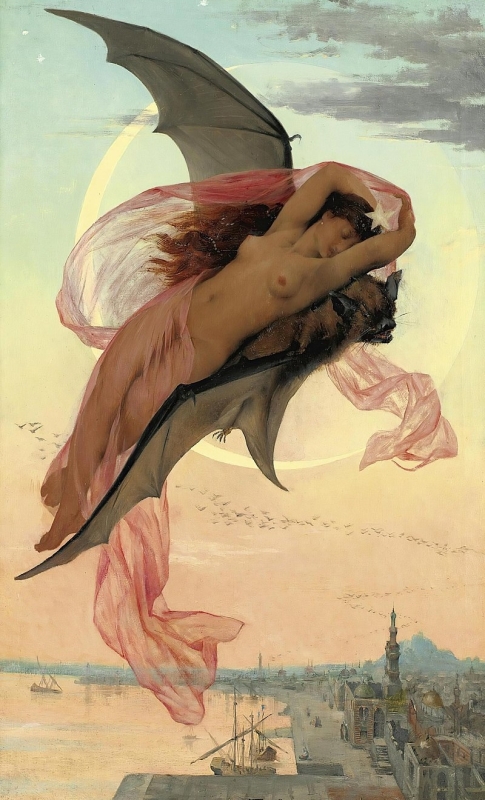
Fig.1 Gabriel Ferrier, Moonlit Dreams, 1874
Bram Stoker's Dracula
Gabriel Ferrier’s 1874 painting ‘Moonlit Dreams’, seen in Fig.1., shows a nude woman resting on the back of an oversized bat and flying gracefully across the pink twilight sky with the crescent moon behind them. The motif of a beautiful woman and an ugly, hairy creature brings to mind the formula of the Beauty and Beast. It also makes me think of the scene from the 1992 film ‘Bram Stoker’s Dracula’ where the Dracula, in the form of a scary and hairy werewolf, rapes the Victorian beauty Lucy Westerna. This could also point to Lucy’s repressed sexual desires and indeed the closed eyes of the woman in the painting make me think that she is dreaming what she cannot have in reality, what she is not allowing herself to have because of morality and propriety. What better way to portray the dreamy hour of dusk and the moonlit dreams in an eroticised than the way Ferrier did it!
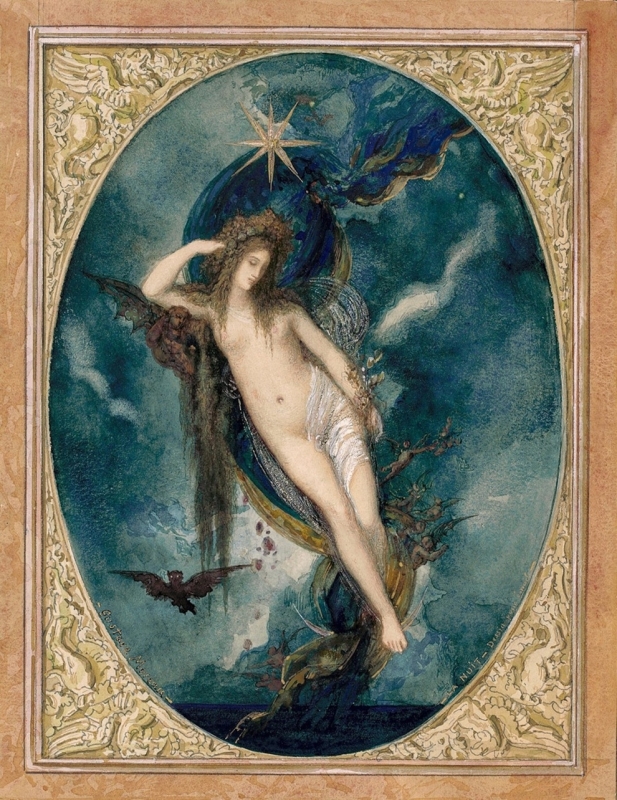
Fig.2 Gustave Moreau, Nyx, Night Goddess, 1880
Night Goddess
In Fig.5., in Mosler’s ‘The Spirit of the Rainbow’, the female body stretches weightlessly across the arc of a rainbow, merging flesh with refracted light. The rainbow itself ceases to be simply a meteorological event and becomes animate, sensual, and alive. Her elongated posture mirrors the curve of the sky, creating a visual continuity between body and atmosphere. The painting transforms an ephemeral natural phenomenon into an embodied presence, suggesting transcendence after storm and the fleeting beauty of light itself.
Similarly, in Moreau’s painting ‘Nyx, Night Goddess’, seen in Fig.2., presents night not as darkness alone but as a feminine cosmic intelligence. Emerging from the deep blue and black tones, the figure appears suspended between revelation and concealment. Her body dissolves into surrounding shadow while stars and symbolic forms radiate around her. Moreau, a key Symbolist painter, often used mythological figures to explore metaphysical and spiritual themes, and Nyx becomes an embodiment of the unknowable vastness of night. Rather than depicting the sky as passive scenery, the artist imagines it as sentient and feminine. The figure’s dreamlike stillness contributes to an atmosphere of mystery and sacredness, hallmarks of Symbolist aesthetics.
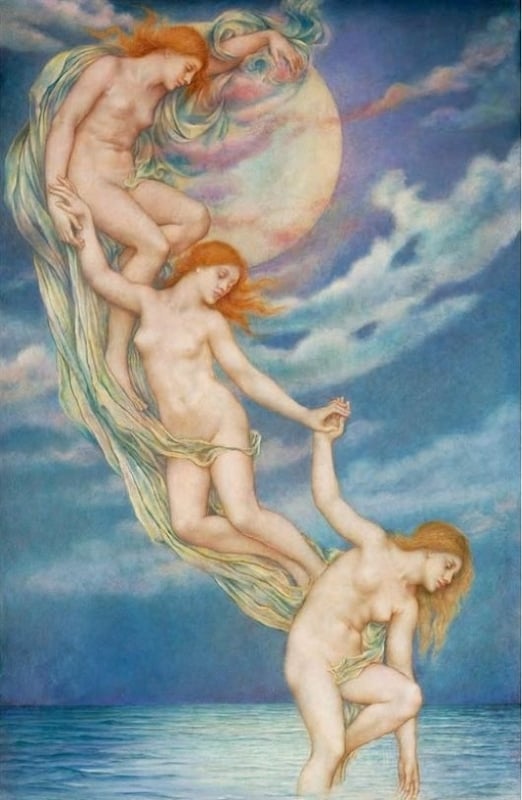
Fig.3 Evelyn de Morgan, Moonbeams Dipping Into The Sea, 1918
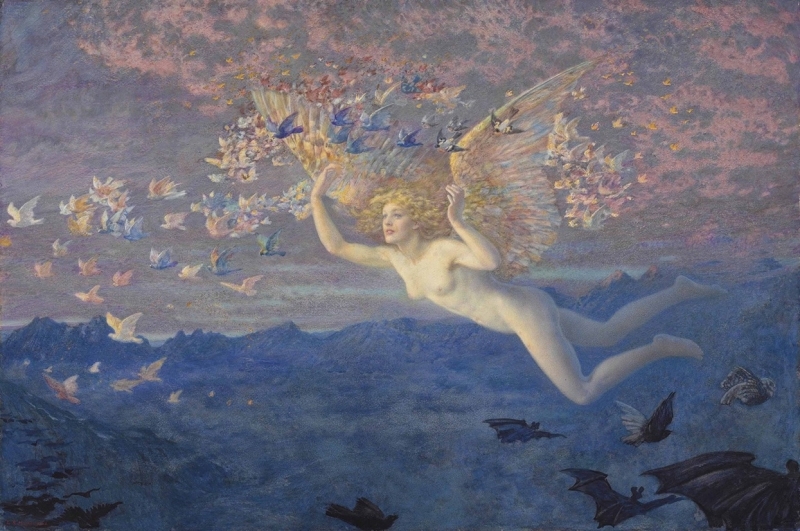
Fig.4 Edward Robert Hughes, Wings of the Morning, 1905
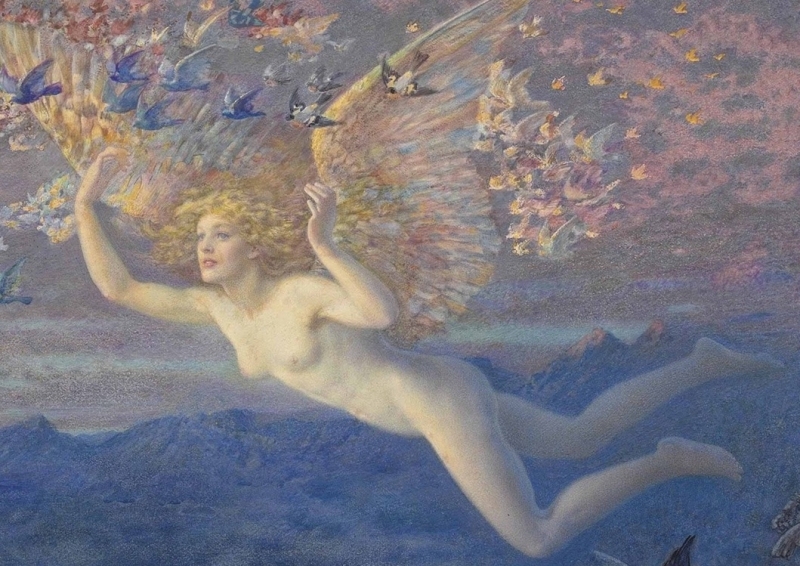
Fig.4a
Wings of the Morning
In Fig.3., in Evelyn De Morgan’s painting ‘Moonbeams Dipping Into The Sea’ develops this idea further by presenting celestial light as descending female bodies. The moonbeams themselves transform into women who gently move between sky and ocean, creating a visual bridge between heaven and earth. The painting emphasizes fluidity, rhythm, and interconnectedness. The figures appear almost immaterial, wrapped in translucent fabrics that resemble currents of light or wind. De Morgan’s interest in spiritualism and mysticism is evident here; the painting suggests that the natural world possesses an inner spiritual life accessible through imagination and symbolism. The feminine form becomes a mediator between cosmic and earthly realms.
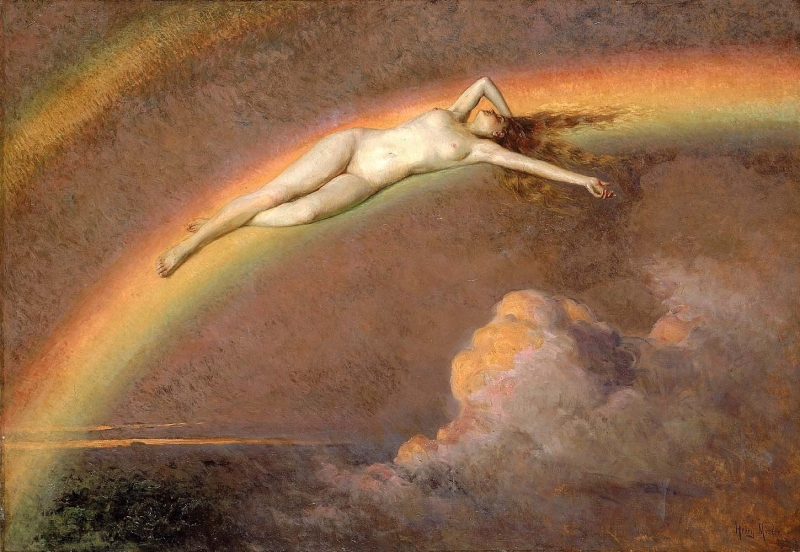
Fig.5 Henry Mosler, The Spirit of the Rainbow, 1912-19
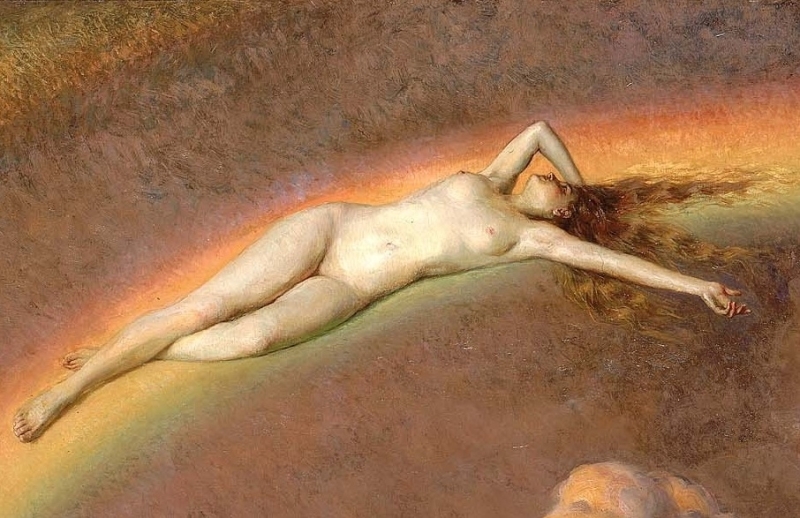
Fig.5a.
Become a Premium member now and discover more about the most striking "Celestial" pieces like: Edward Robert Hughes’ 1905 painting ‘Wings of the Morning’, Akseli Gallen-Kallela’s painting ‘Ad Astra’, Alexey Golovin’s 2015 painting ‘Andromeda ', Karl Wilhelm Diefenbach's 1901 painting 'Asking the Stars', Jean-Francoise Millet’s 1849 painting ‘The Shooting Stars’, how these paintings reveal the complexity of gendered symbolism in fin-de-siècle art, and MUCH more...!!
Click HERE for an article about the erotic power, visual excess, and the afterlife of the God Priapus
Let us know your thoughts about this article in the comment box below...!!