
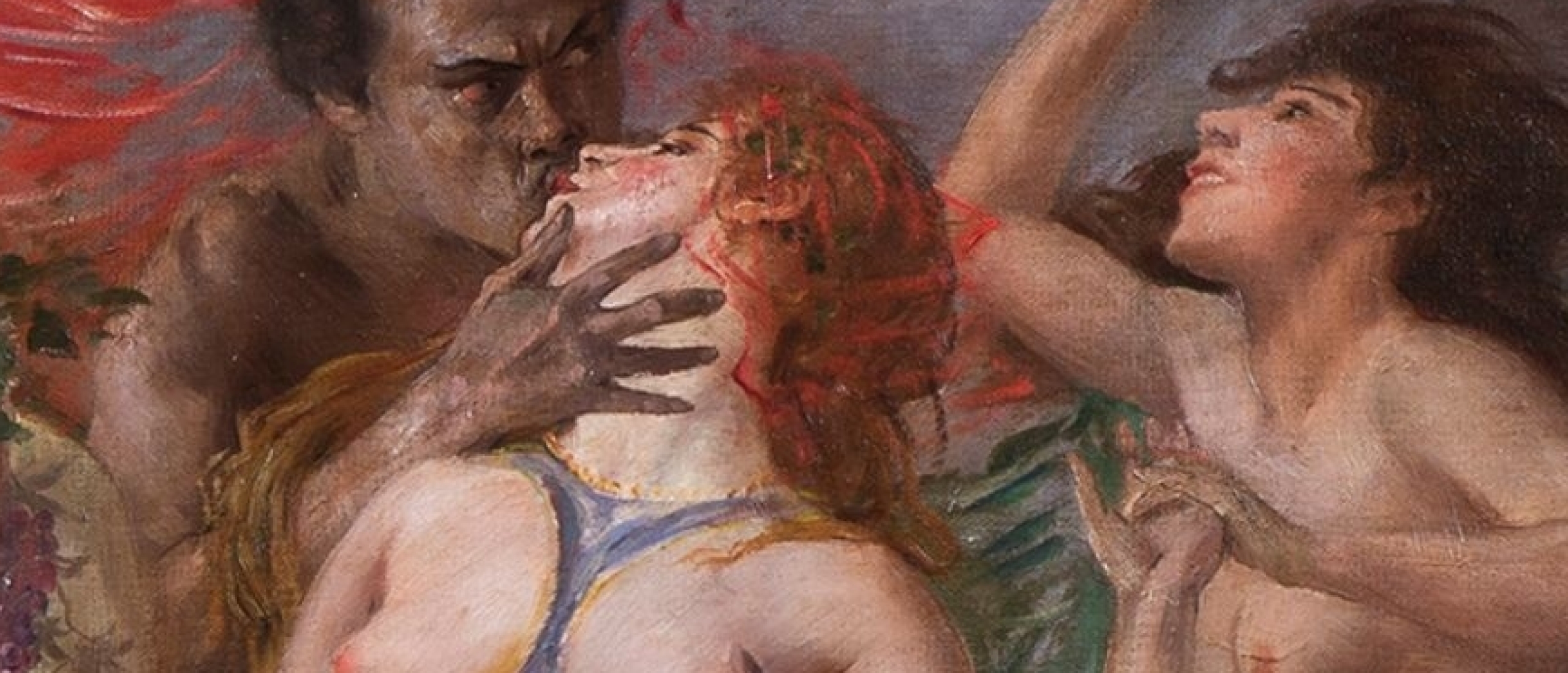

Lovis Corinth’s painting ‘Bacchanalia’, painted in 1896, stands as one of the most visceral interpretations of Dionysian ecstasy in the late nineteenth-century European painting. Unlike the controlled classicism of Renaissance Bacchanals or the decorative lushness of academic mythological scenes, Corinth’s painting is vibrant and pulsating with physical urgency. This is not a polished allegory of pleasure but a convulsive eruption of flesh, wine and instinct. Painted at a moment when Corinth was moving away from academic restraint toward a more expressive, psychologically charged realism, ‘Bacchanalia’ is a sort of threshold, a decisive break: myth becomes an excuse not for beauty, but for excess. At first glance, the painting overwhelms. Bodies crowd the canvas, entangled in a dense, almost claustrophobic composition. There is no stable focal point, no clear hierarchy of figures. Instead, limbs, torsos and faces collide in a heaving mass. The viewer is not positioned at a safe observational distance; they are pressed into the scene, nearly absorbed by it. This spatial compression is crucial. Corinth denies the viewer the comfort of perspective, replicating the very sensation of Dionysian loss of control.
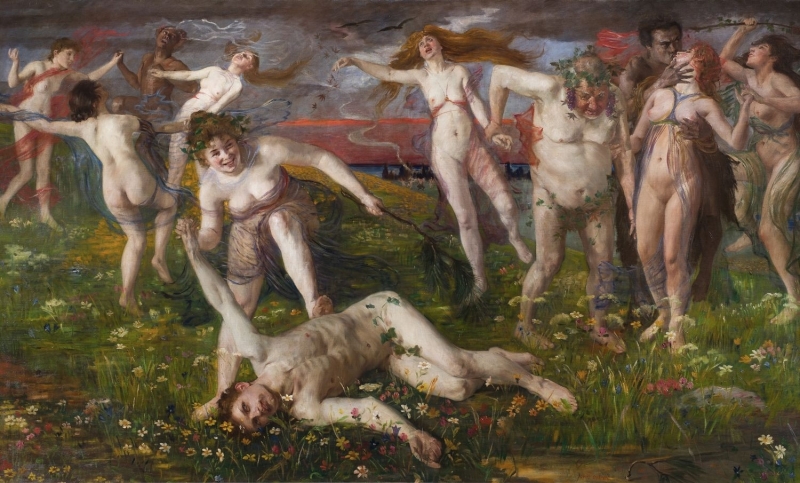
Fig.1 Lovis Corinth, Bacchanalia, 1896
Restless Energy
Lovis Corinth (1858-1925) was a painter who stood at a fascinating crossroads between tradition and modernity. Born in 1858, he belonged to a generation that had inherited the discipline of academic painting yet felt increasingly drawn toward the emotional freedom that would define modern art. Early in his career, Corinth’s work was rooted in realism: portraits, mythological scenes, and richly painted nudes rendered with remarkable technical skill. Yet even in these works there was already a certain intensity, a restless energy in the brushwork that hinted at something more expressive beneath the surface.
Titian’s Bacchanals
Corinth’s ‘Bacchanalia’ rejects the classical ideal of balanced composition traditionally associated with mythological scenes. Whereas Titian’s bacchanals unfold in choreographed rhythms and Poussin’s revellers maintain sculptural clarity, Corinth’s figures appear unstable, mid-motion and precarious. Bodies tilt and lunge, threatening to spill beyond the frame. The composition is centrifugal rather than harmonious, as if the energy of the revel cannot be contained by the canvas. This instability is not accidental. It mirrors the thematic content of Bacchanalia itself: the dissolution of order. Dionysian ritual, by definition, undermines Apollonian ideals of clarity, proportion, and self-mastery. Corinth translates this philosophical tension into painterly terms. The lack of compositional rest becomes a visual analogue for intoxication. The eye cannot settle; it is dragged from one gesture to another, mimicking the restless attention of the drunk or entranced participant.
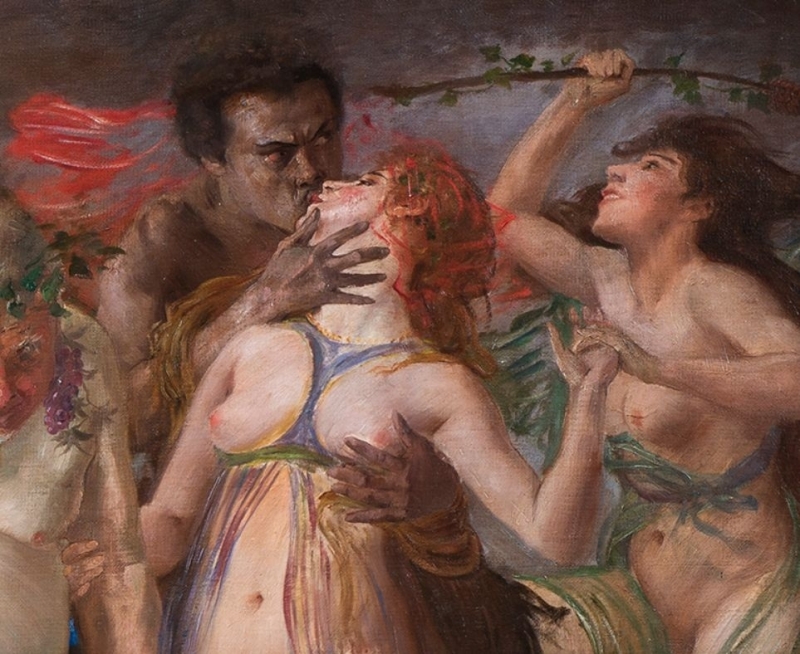
Fig.2
Weightless Nudes
One of the most striking aspects of Corinth’s painting is the treatment of the human body. These are not idealised, weightless nudes. They are heavy, flushed, sweating bodies, rendered with thick paint and emphatic brushwork. Flesh presses against flesh with a sense of mass and gravity. The eroticism of the painting arises not from smoothness or polish, but from density.
Vessels of Experience
Corinth emphasises the corporeality of his figures; bellies protrude, thighs strain, shoulders hunch. The bodies feel warm, damp and tactile. This emphasis on physicality aligns Corinth with a modern sensibility: the body is not an abstract symbol of beauty but a site of sensation, appetite, and vulnerability. The Bacchanalian body here is not transcendent; it is insistently earthly. Eroticism emerges through proximity rather than display. Many figures are partially obscured, their nudity fragmented by overlapping forms. This fragmentation heightens intimacy. The viewer glimpses rather than surveys. A breast appears between arms; a thigh presses against a back. Desire is dispersed throughout the mass, unlocalised and collective. If the bodies convey weight, the faces convey surrender. Several figures appear flushed, mouths open, eyes unfocused or closed entirely. These are not expressions of seduction directed toward the viewer. Instead, they suggest absorption; into rhythm, intoxication, or divine possession. The figures are no longer self-conscious subjects; they are vessels of experience.
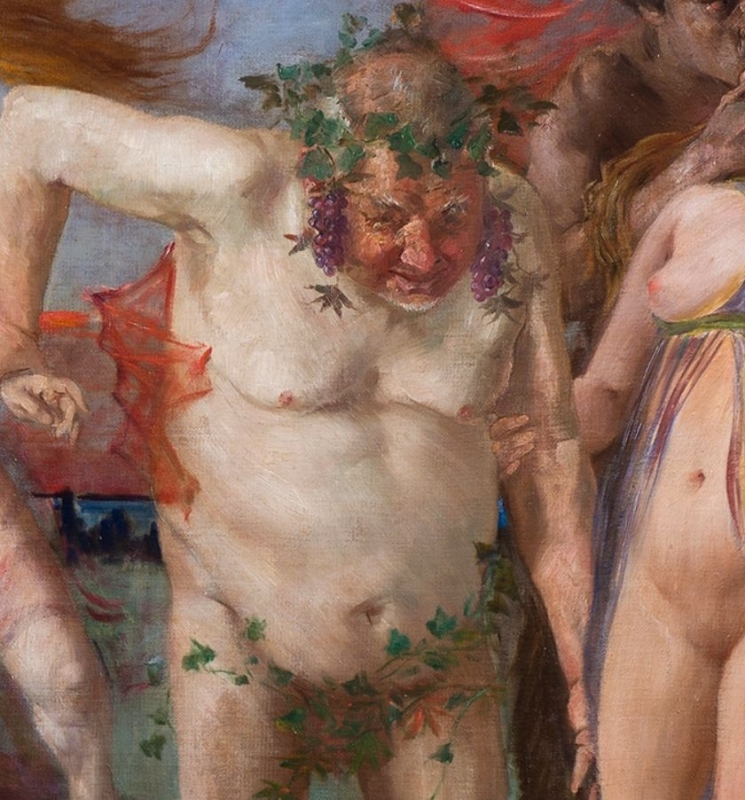
Fig.3
Become a Premium member now and check out the extended version of this article and many other examinations of single artworks.
Click HERE for a closer look at the subversive Lowbrow masterpiece "Appetite for Destruction" by Robert Williams
Let us know your thoughts about the article in the comment box below...!!