

The Erotic Mirror Of the Edo Period: Narrative Strategies In Utagawa Toyokuni's Ehon Kaichu Kagami - Part 1
UTAGAWA TOYOKUNI AND THE NARRATIVE POTENTIAL OF SHUNGA
The work 絵本開中鏡 (Ehon Kaichū Kagami), attributed to Utagawa Toyokuni 歌川豊国 (1769–1825), occupies a significant place in the history of Japanese woodblock printing of the Edo period, particularly from the moment the artist chooses not merely to create fixed pictures but images that relate to one another through the continuity established between them. Structured in three illustrated volumes, the publication gathers prints that belong to the tradition of shunga, an erotic genre widely disseminated in Japanese visual culture between the seventeenth and nineteenth centuries. The analysis of this set makes it possible to observe not only formal aspects of Toyokuni’s production but also characteristics of the Utagawa school. When the three volumes are considered as parts of the same editorial structure, the book can be understood as a repertoire of erotic situations that explore relationships between characters, domestic spaces, and bodily gestures.
Utagawa Toyokuni was one of the most influential artists of the Utagawa school, founded by Utagawa Toyoharu at the end of the eighteenth century. The school consolidated itself as one of the principal centers of ukiyo-e production, especially in the areas of portraits of kabuki actors and representations of courtesans. Toyokuni was a direct disciple of Toyoharu and developed a career that placed him among the most prominent illustrators of his generation. His work helped consolidate the school’s aesthetic, characterized by figures with strong graphic presence, firm lines, and expressive compositional arrangements. Although Toyokuni is remembered primarily for his portraits of actors, his production also includes book illustrations and erotic prints.
During the Edo period, shunga occupied an ambiguous position within visual culture. Despite periodic restrictions imposed by the Tokugawa government, erotic images circulated widely. Illustrated books and erotic albums were produced by some of the most important artists of ukiyo-e, including Hokusai, Utamaro, Harunobu, and Kiyonaga. The eroticism in these books was not limited to the explicit representation of sexual acts, since it also functioned as a space for graphic and narrative experimentation. Composition, spatial arrangement, and interaction between characters allowed artists to explore different forms of bodily proximity.
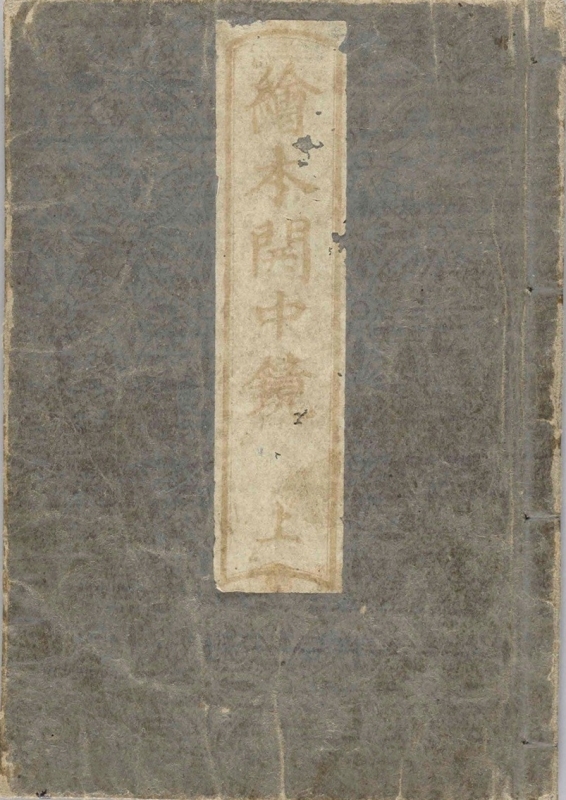
Fig.1
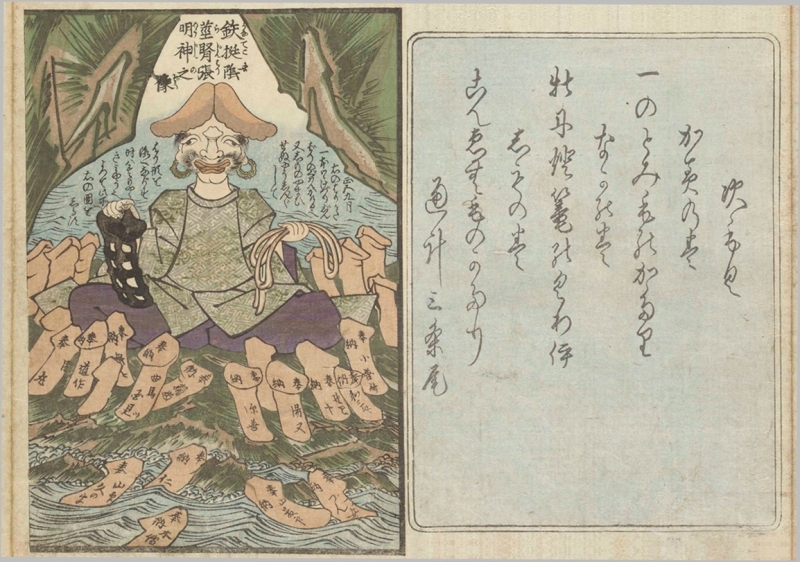
Fig.2
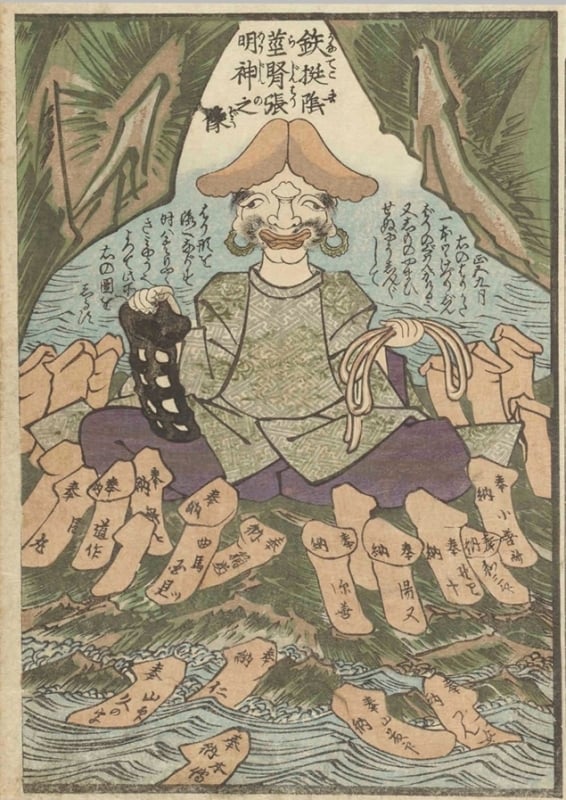
Fig.2a
THE MEANING OF THE TITLE
The title 絵本開中鏡 (Ehon Kaichū Kagami) can be translated approximately as “Mirror Opened in an Illustrated Book”, “A Mirror Revealed in Images, or "Mirror of the Vagina)” depending on how the compound 開中鏡 is interpreted. The word kagami (鏡, mirror) frequently appears in Japanese literary and editorial traditions, evoking both the idea of moral reflection and that of visual revelation. In illustrated books of the Edo period, the “mirror” often designates a work that “reflects” social types, famous actors, or contemporary fashions.
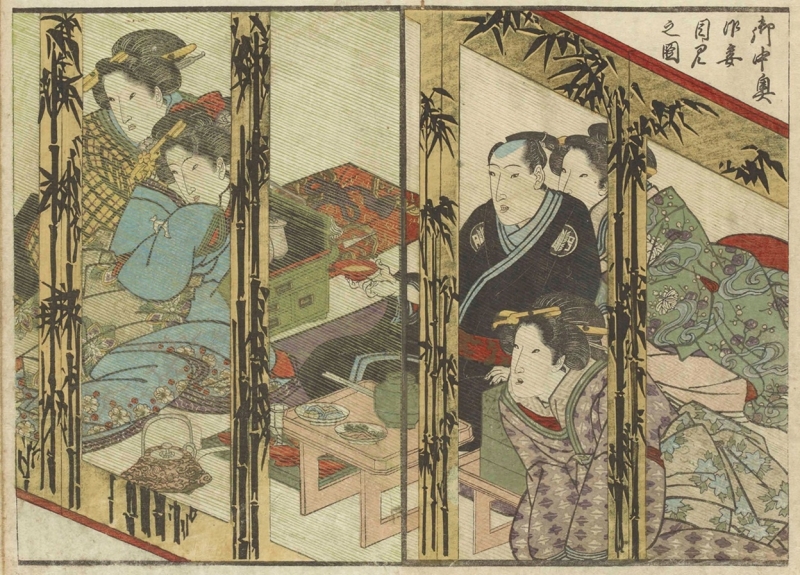
Fig.3
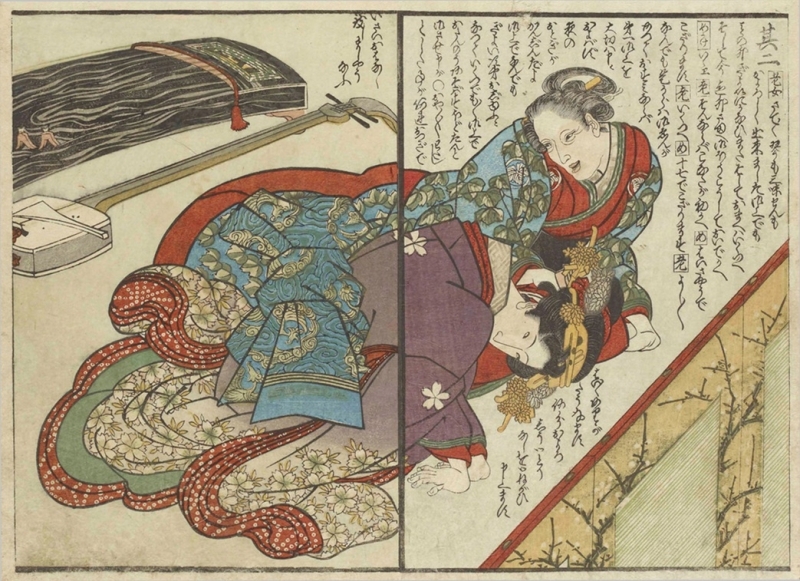
Fig.4
THE GROTESQUE ALLEGORY THAT OPENS THE BOOK
The first figurative image of the book presents an allegorical and grotesque scene that functions as the visual introduction to the work. It depicts a male figure seated frontally, with the body turned directly toward the viewer, probably a fertility god. The character possesses caricatural features: an elongated face, an exaggerated smile, and an extremely long nose that dominates the physiognomy. The nose is not merely a comic detail, as it has a shape resembling a penis, creating a deliberately obscene effect. This type of bodily exaggeration was common in the humorous iconography of the Edo period, especially in works related to eroticism, since it transformed the body into a space of explicit sexual metaphors. The figure sits with his legs spread apart in a static, almost ceremonial position. His clothing consists of a simple, loose robe. In his right hand he holds a dildo, and in his left a rope, reinforcing the sexual character of the image. The head is covered by a tall ornament whose silhouette resembles a penis. Around the character, in the upper portion, there are two giant vulvas, one on the right side and another on the left, as if they were curtains. On the ground, votive tablets in the shape of penises surround the phallic deity, with inscriptions written in Japanese characters:
女 (onna) — “woman”
男 (otoko) — “man”
恋 (koi) — “love / passion”
欲 (yoku) — “desire”
色 (iro) — “lust / sensuality”
情 (jō) — “feeling / passion”
好色 (kōshoku) — “libertinism / lust.
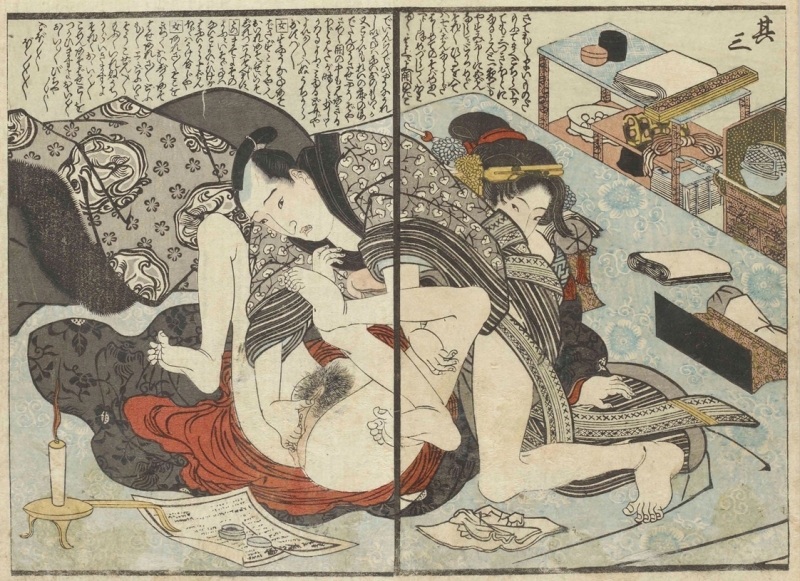
Fig.5
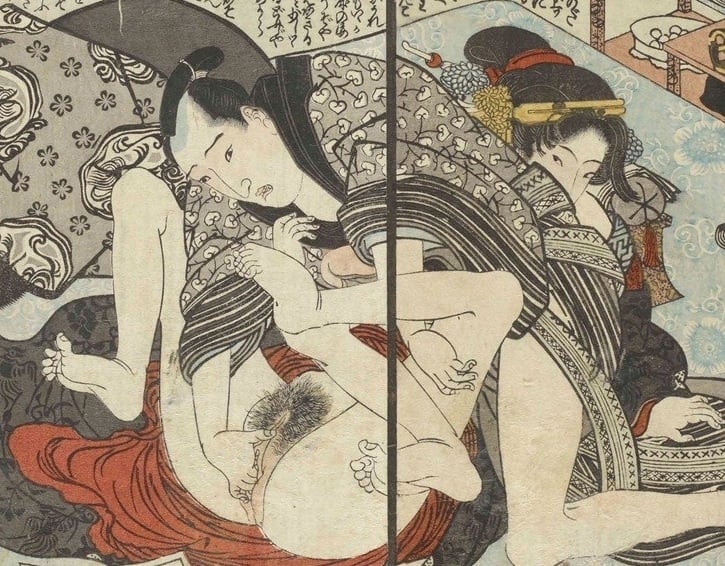
Fig.5a
Beside the image there is a text written in kuzushiji, arranged in vertical columns. It functions as a literary introduction to the book. The text presents a reflection on the nature of human desire and explains the central idea of the work. An approximate translation of the passage can be expressed as follows:
“Since ancient times, men and women have lived moved by desires that arise from within the body. Even if they attempt to hide them beneath rules and respectable appearances, when the moment comes those impulses inevitably reveal themselves. Just as a mirror shows what stands before it, this book reveals what lies within the hearts of people. Some may laugh when seeing these images, others may feel ashamed, but all will recognize that such desires are part of human nature.”
The text presents the book as a mirror of the human interior, an idea reinforced by the word kagami (“mirror”) present in the title of the work. In this sense, eroticism is not presented merely as visual stimulus but as a means of revealing what normally remains hidden. Thus, the grotesque figure of the opening image, with its penis-like nose and the phallic object held in its hands, functions as a direct visual metaphor for the force of sexual desire that runs throughout the narrative of the book.
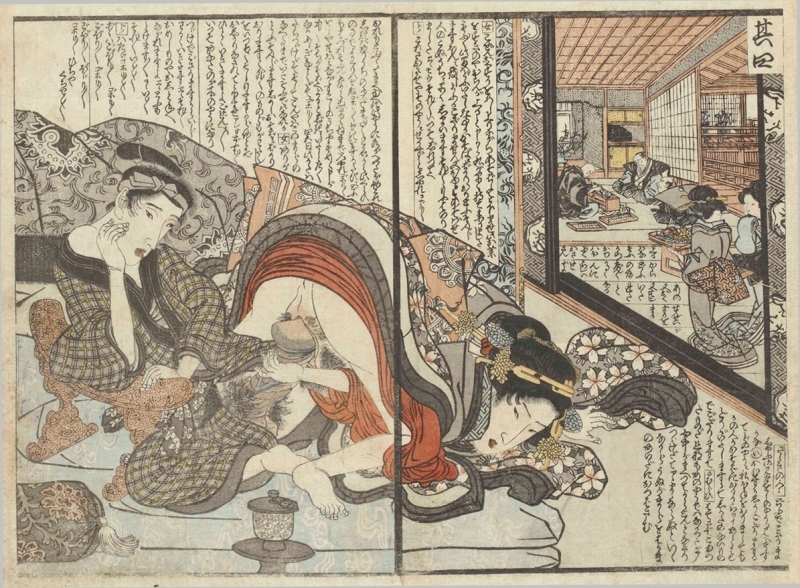
Fig.6
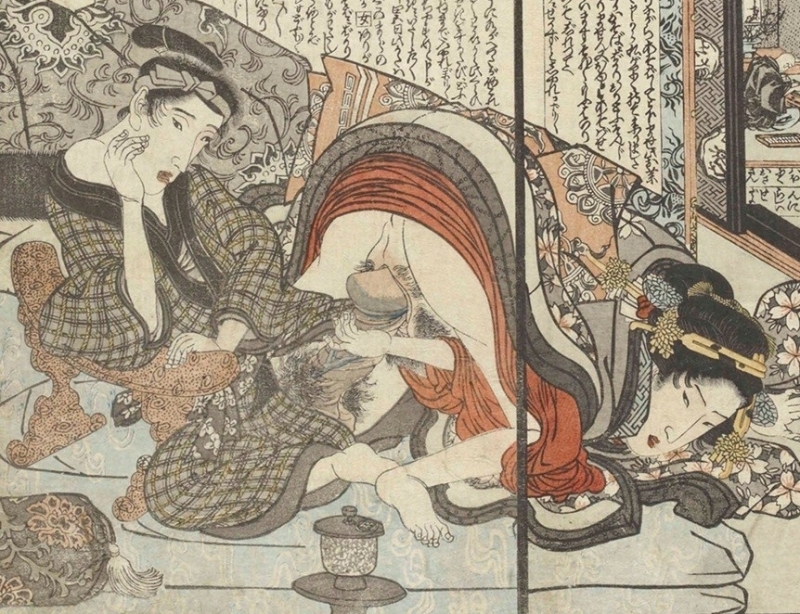
Fig.6a
VOYEURISM AND SEQUENTIAL STORYTELLING
The second image presents a group composed of one man and three women. The composition directs the gaze of these characters toward a space outside the visible field of the image, creating a visual expectation that remains without immediate answer. This compositional strategy functions as a narrative device: the reader is led to ask what exactly those figures are observing. The answer appears only when the following page is revealed. Upon turning the page, the viewer encounters the intimate scene of two women involved in a secret encounter, represented inside a bedroom. The revelation of the scene retrospectively transforms the previous image into a moment of voyeurism: the initial group becomes a set of silent witnesses observing, from a distance, the unfolding of a forbidden relationship. In this way, Toyokuni uses an extremely simple device, the physical act of turning the page, to produce a narrative effect that anticipates mechanisms typical of the sequential language of comics. The scene of the encounter between the two women is accompanied by small fragments of text that reinforce the clandestine character of the situation. The narration establishes the temporal and emotional context of the moment:
“It was already late at night and everything in the house was silent. Taking advantage of the fact that no one was nearby, the two drew closer to each other."
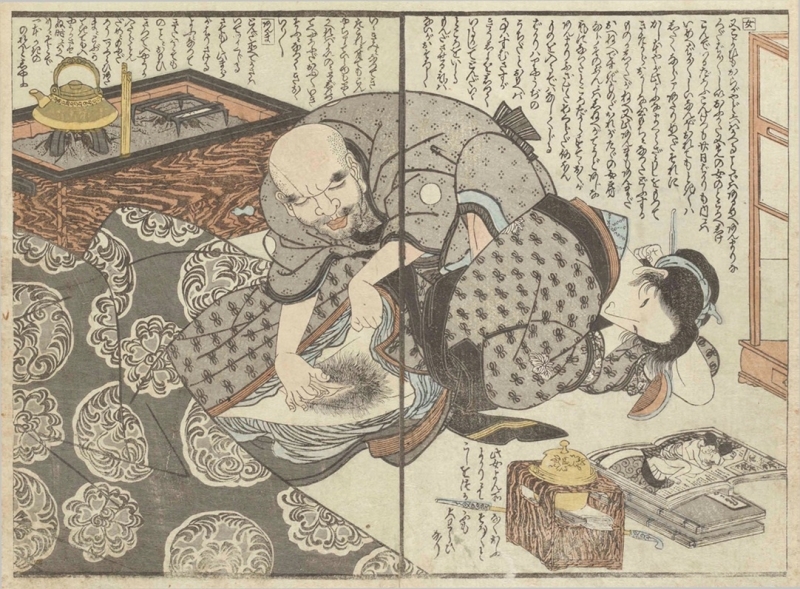
Fig.7
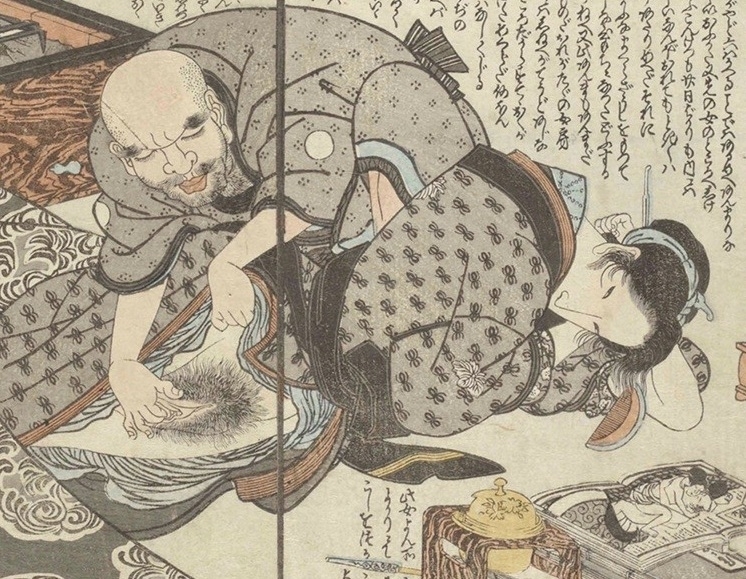
Fig.7a
The silence of the house and the absence of direct witnesses create the atmosphere of intimacy that makes the encounter possible. However, the presence of the group on the previous page suggests that this isolation is only apparent. The dynamic between the two characters is also structured around a difference of experience. The woman positioned on the right, apparently older, adopts a more confident and reassuring posture. Her gesture of approach is accompanied by words meant to calm her companion’s hesitation:
“Don’t be so nervous… no one will come at this hour. Come closer.”
The younger woman, in turn, expresses concern about the possibility of being discovered:
“But… if someone sees us like this… what will we do?”
This brief dialogue introduces into the scene an element of dramatic tension typical of Edo-period erotic narratives, in which desire often develops under the risk of public exposure.
Despite the initial hesitation, the text indicates that the approach between the two women intensifies. A small narrative comment observes that:
“Even while saying this, she did not move away. On the contrary, she drew even closer.”
The contradiction between the cautious words and the gesture of proximity highlights the force of desire driving the scene. The encounter culminates in a moment of suspension from the outside world, summarized by the final narration:
“Thus, forgetting what was around them, the two remained together in that moment.”
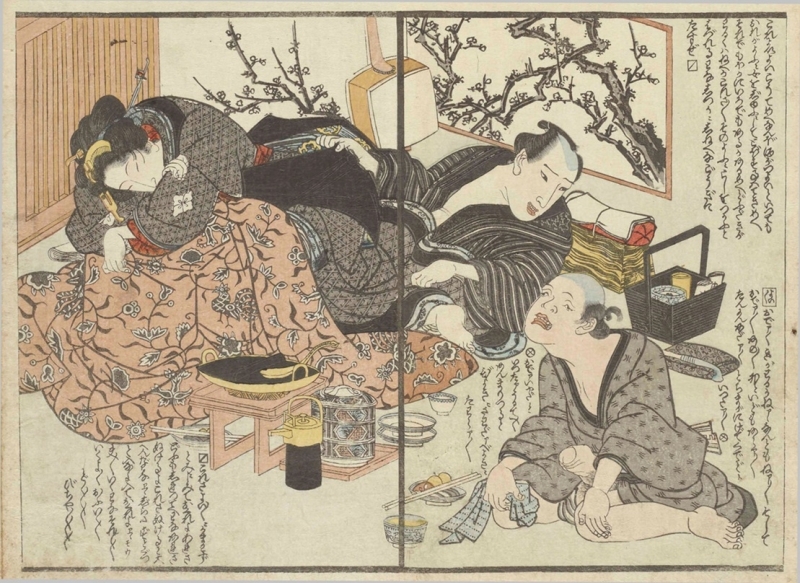
Fig.8
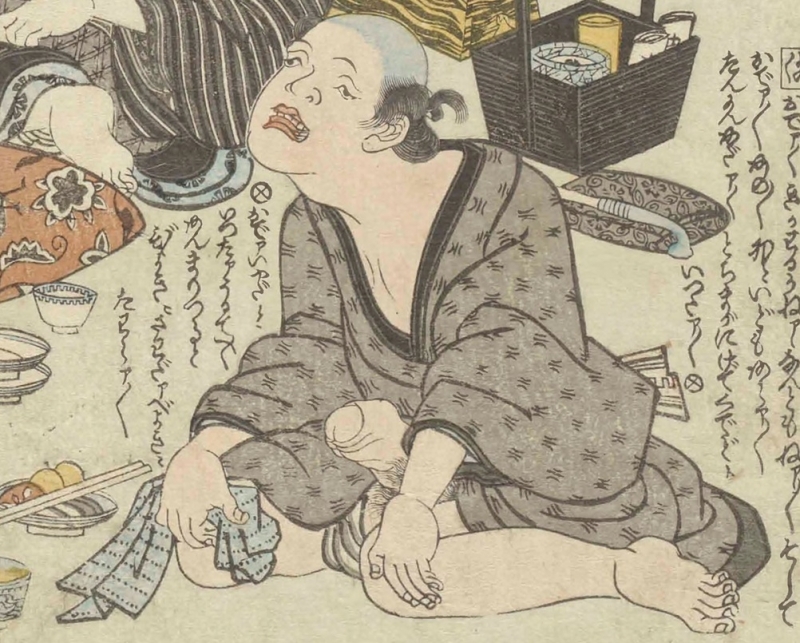
Fig.8a
By relating this scene to the preceding image, Toyokuni creates a game of gazes that involves not only the represented characters but also the reader. The group formed by one man and three women functions as an intermediary between the intimacy of the couple and the gaze of the observer. They look to the left, toward something we cannot yet see; the reader, by turning the page, comes to share their gaze and discovers the object of their curiosity. In this way, the narrative is constructed through a chain of observation: characters observe other characters, while the reader observes them all.
This device reveals remarkable narrative sophistication. Instead of presenting simply an isolated erotic scene, Toyokuni organizes the images in such a way as to produce a visual sequence that articulates expectation, revelation, and voyeurism. The turning of the page becomes, therefore, a fundamental narrative mechanism capable of converting two independent images into a continuous episode. In this sense, the work demonstrates how Edo-period erotic woodblock prints already explored complex visual strategies to suggest stories and relationships between successive images.
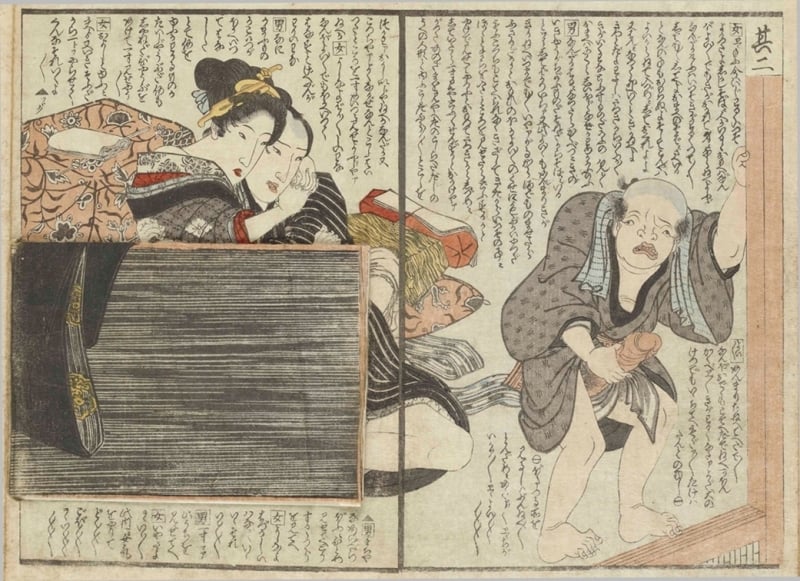
Fig.9
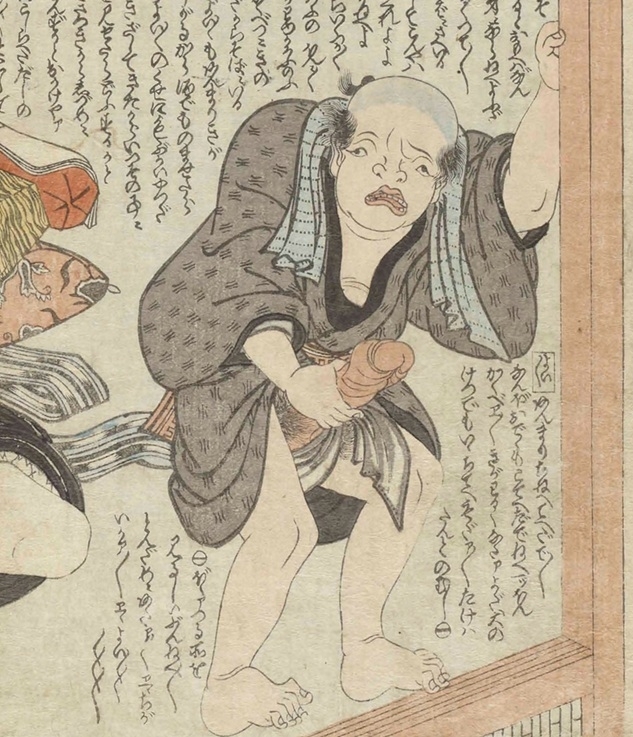
Fig.9a
A NARRATIVE OF DISCOVERY AND EXPOSURE
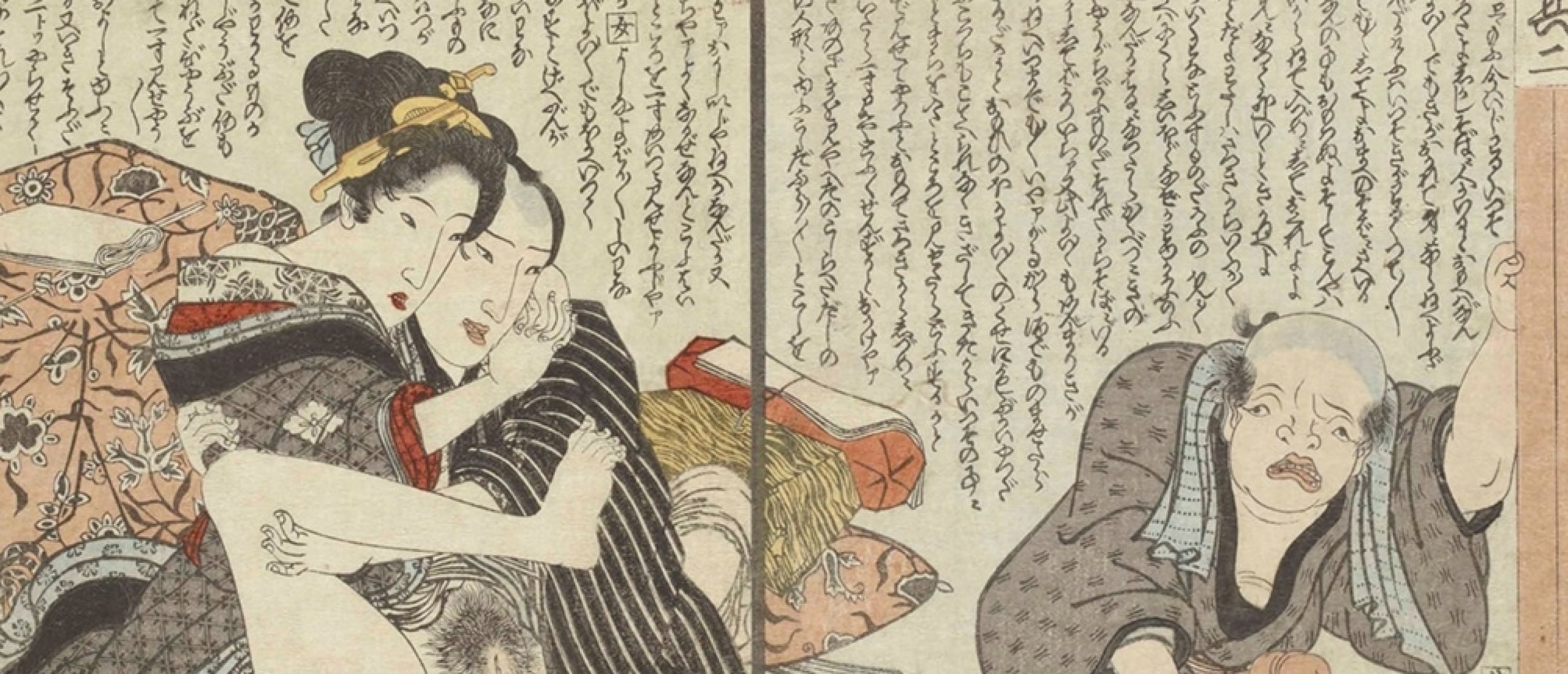
Two other images from the Ehon Kaichū Kagami also form a short narrative sequence constructed in two stages: the latency and the revelation of the act. In the first image, a domestic interior is seen organized around an intimate tension. On the left, a couple is reclining: the woman appears under a richly patterned kimono, in a resting posture, while beside her a young man is partially covered. The initial atmosphere suggests quietude. On the right side of the composition, separated by the central fold of the page, an older man appears, with a shaved head, a towel around his neck, an attentive expression, and a crouching posture. Around him are containers, food, trays, and utensils that reinforce the everyday environment and reveal his identity: he is a household servant. The text accompanying the scene, in an approximate translation, suggests embarrassment and sudden discovery: "It was exactly at that moment that the old man entered the room," and upon realizing what he sees, he reacts like someone surprised by a situation he did not expect to find.
However, the text also reveals his comic voyeurism towards the scene, as he comments that he is there only to prepare the tea and take care of everything, confessing to feeling a strong envy of the couple's enjoyment:
"They seem to be having a lot of fun... and here I am, just preparing the tea and taking care of everything. I am so jealous of those two... my body also responds just from hearing their sounds."
In the second image, a decisive change occurs, as the couple is no longer merely reclining; the woman is now sitting on top of the man, in the midst of the sexual act. The position is unequivocal, and what draws attention is the concentration of the bodies and the complicity of their gestures. On the right, the older man does not retreat out of shame or outrage. On the contrary, the image reveals his state of vicarious excitement: he holds his own erect penis, reacting physically to what he is witnessing. The scene oscillates purely between the erotic and the comic, depicting the classic trope of the "excited spy," which is very common in the shunga genre.
A large dark block functions as a central visual device for the sequence. It obstructs the gaze, blocks the view, and creates an interval between appearance and revelation. It can be read as a folding screen, a lid, a shield, or even a displaced wooden pillow (takamakura), but it acts strongly as a metalinguistic resource: the book itself seems to temporarily cover what, upon turning the page, will be shown explicitly. When this block disappears or is surpassed by reading, the "real event" is revealed in its entirety.
What we see in the images is the revelation of a triangular scene grounded in voyeurism: a couple engages in intimate relations, while a subordinate spies on them. The translated text affirms this situation, since the older character is not scandalized, but rather participating from a distance in that sexual scene. Toyokuni inserts a grotesque element into him that makes the situation inseparable from the ridiculous.
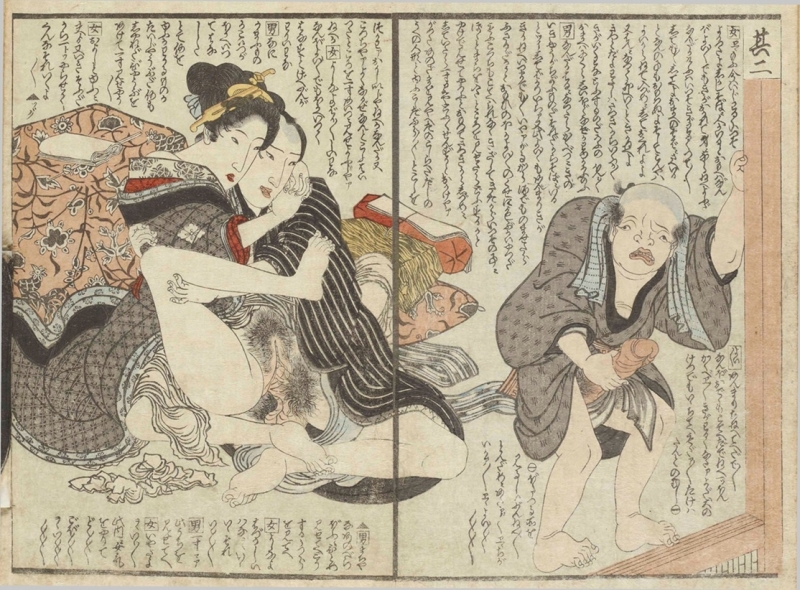
Fig.10
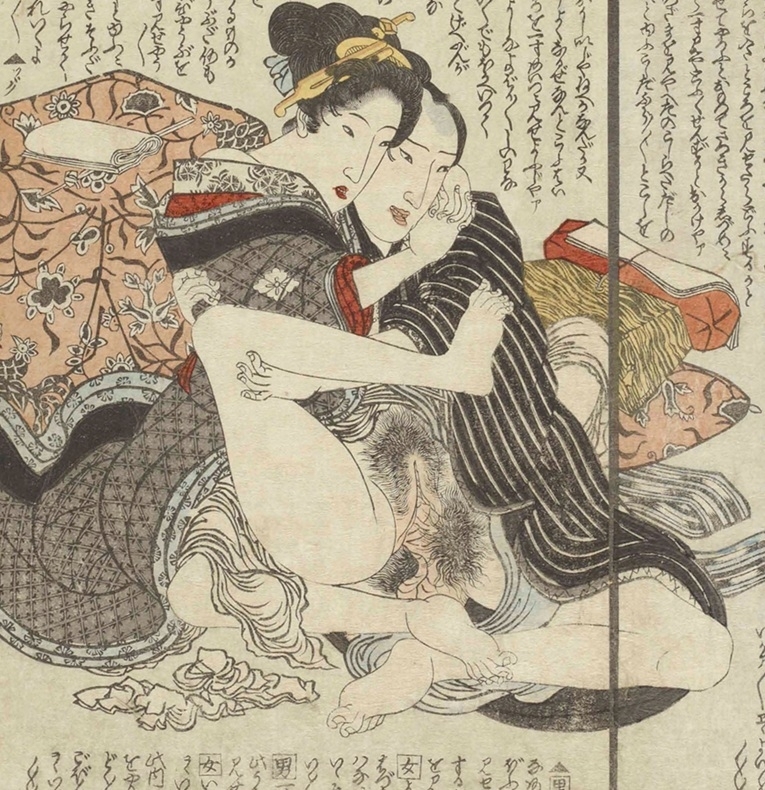
Fig.10a
There is also a very strong social and corporal contrast between the figures. The young couple is depicted with elegance, formal continuity, and visual harmony. On the other hand, the older man is drawn in a caricatured manner: exaggerated features, a hunched body, a convulsed expression. His exaggerated anatomy reinforces his function as a comic counterpoint. While the couple experiences a "real" and integrated sexuality, he appears linked to a peripheral, stealthy, and solitary sexuality. This produces a typical shunga effect: the eroticism does not eliminate the humor, but rather intensifies it.
The visual treatment confirms this reading. In the couple's area, ornamental fabrics, curves, and integration between the bodies predominate. In the intruder's area, the figure appears isolated, angular, and almost displaced from the rest of the composition. The central fold of the page functions as a symbolic divider between two regimes: on one side, the intimacy and fluidity of the couple; on the other, the irruption of comic vigilance and the grotesque. Thus, the event in the images is structured in an ingenious way. The play between hiding and revealing, intensified by the book format and the transition from one image to another, transforms a bedroom scene into a dynamic visual narrative, combining eroticism, humor, and the omnipresence of observation in Edo period Japan.
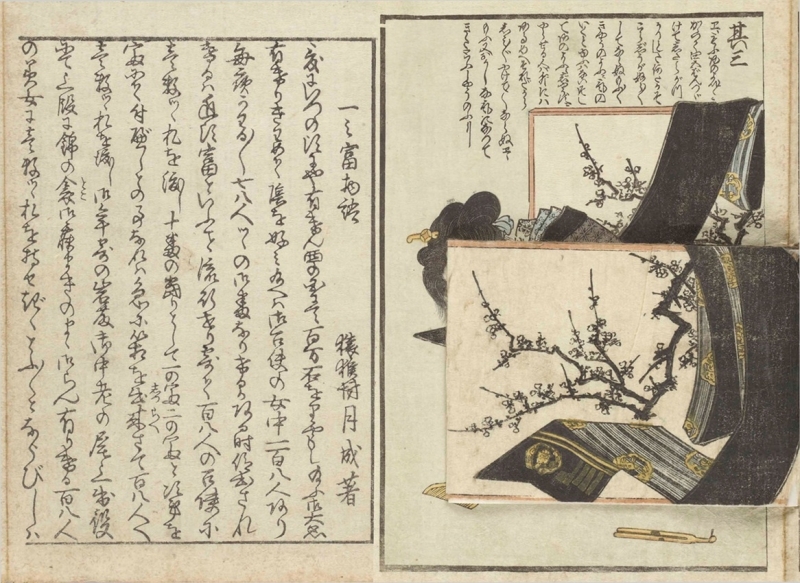
Fig.11
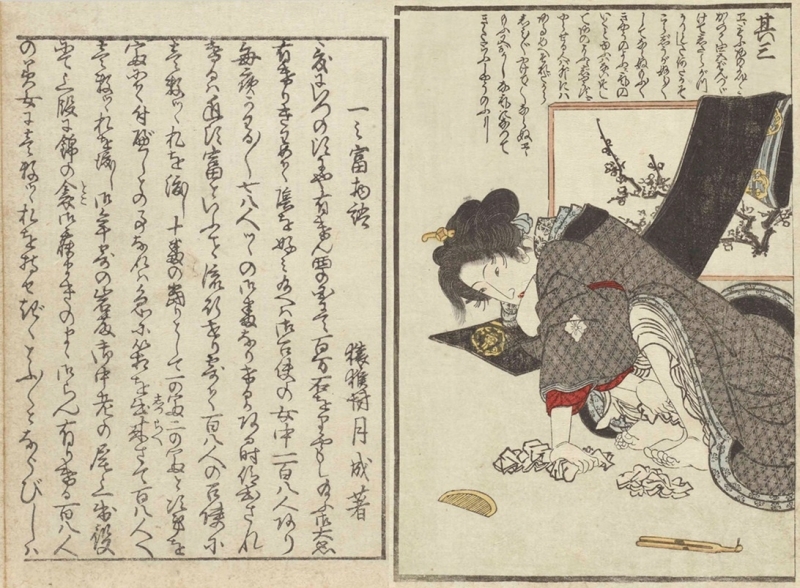
Fig.12
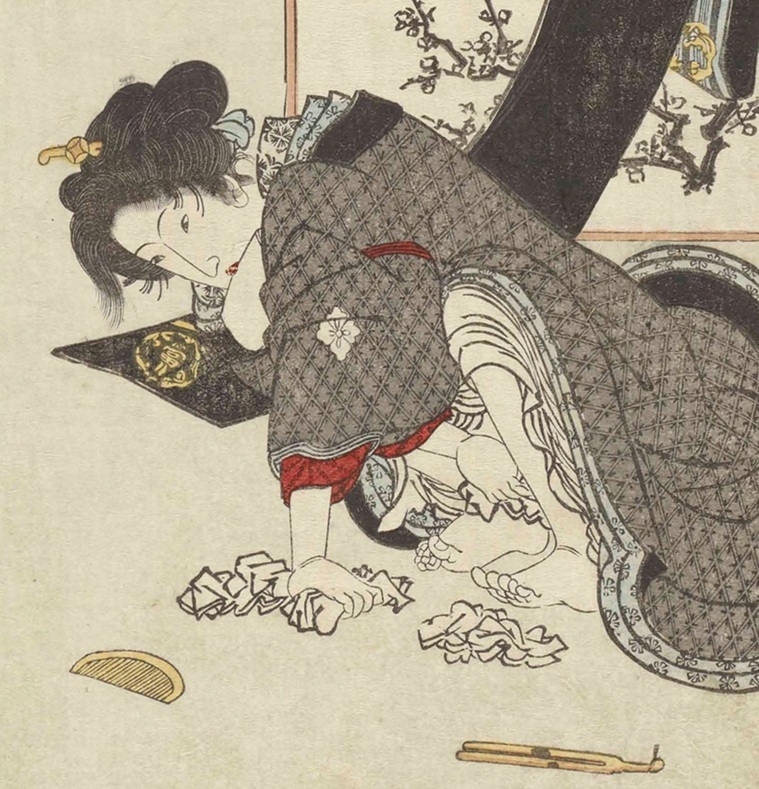
Fig.12a
To Be Continued
Part 2 will explore the remaining narrative episodes of Ehon Kaichū Kagami, including the role of humor, voyeurism, and grotesque imagery in Toyokuni’s erotic storytelling, as well as the broader relationship between shunga and sequential visual narrative in Edo-period illustrated books.
Become a Premium member now and check out Part 2 and 3 discussing the complete book series Ehon Kaichū Kagami (Mirror of the Vagina) ..!!
Click HERE for a post discussing the design of figure 7 depicting the bald, blind masseur
What do you think about this review of the first volume of Toyokuni's Ehon Kaichū Kagami ? Leave your reaction in the comment box below..!!